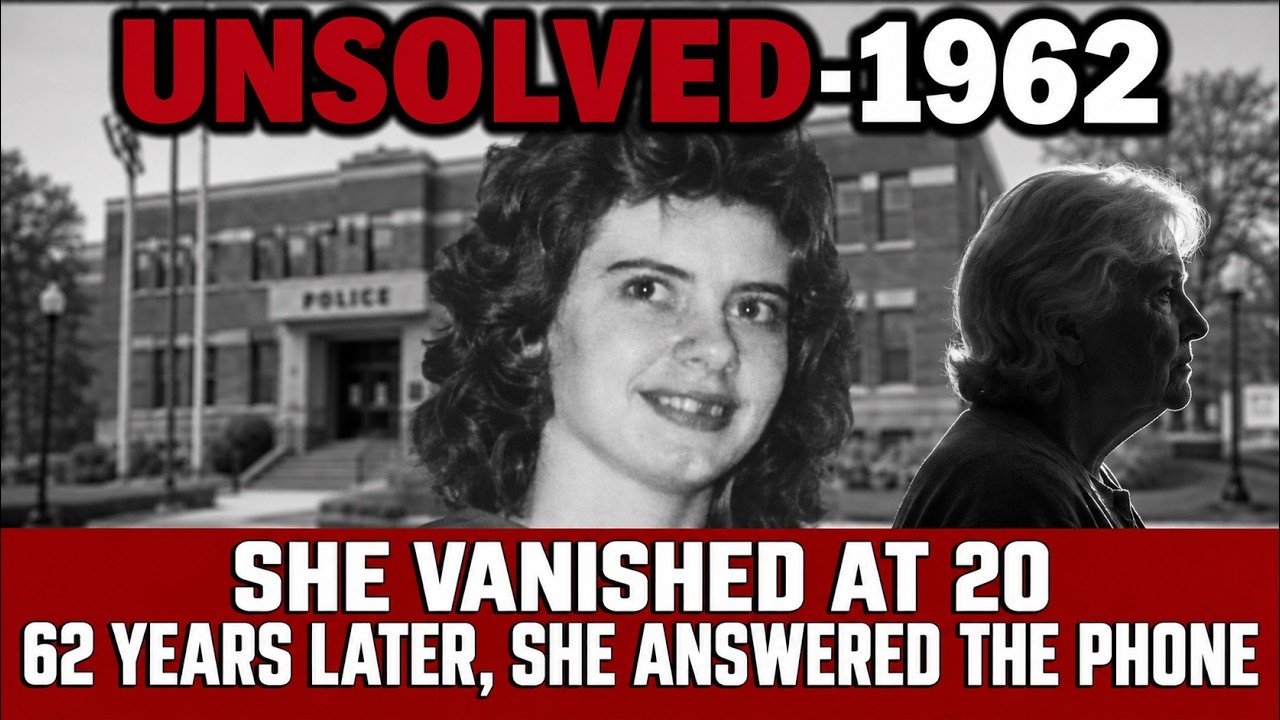
WISCONSIN 1962 Cold Case Solved After 62 Years — She Was Alive the Whole Time
...
In Indianapolis, Barbara got scared.
She was 14 years old.
She was hundreds of miles from home with no plan and no money and no idea what came next.
She turned herself into the Indianapolis Police Department as a runaway.
She told the officers that Audrey had refused to return and was last seen walking around a corner near the bus station, away from everything she'd ever known and into whatever came next.
That image is worth sitting with.
A 20-year-old woman in a summer dress carrying almost nothing, walking around a corner in a city where she knew nobody.
300 m from home with no plan beyond not going back.
Audrey Jean Bakabberg, 20 years old, 5'5 in tall, 125 lb, brown hair, hazel eyes, a distinguishing crooked left index finger, missing.
Back in Reedsburg, the investigation began immediately, and the focus of that investigation landed exactly where you would expect it to land.
Ronald Backerberg had been publicly accused of beating his wife and threatening to kill her.
Three days later, she vanished.
In the mathematics of criminal investigation, that equation produces a single obvious answer.
And everyone in Reedsburg was doing the math.
The neighbors, the shopkeepers, the people at the mill where Audrey worked.
Everyone looked at Ronald and thought the same thing.
Ronald denied everything.
He said he had nothing to do with her disappearance.
He said he didn't know where she was.
He said he had no idea what happened.
Investigators brought him in for a polygraph examination.
The kind of test designed to measure physiological stress responses, changes in heart rate, blood pressure, skin conductivity, the invisible signatures of deception.
Ronald passed.
The investigators weren't satisfied.
You don't file a report alleging death threats and beatings, disappear 3 days later, and get your husband cleared on a single polygraph.
In November 1964, more than 2 years after Audrey vanished, the Wisconsin State Crime Lab administered a second lie detector examination.
During this test, Ronald stated clearly that he had not heard from Audrey since the day she disappeared.
He had no knowledge of where she was.
He had no involvement in her leaving.
He passed that one, too.
Now, polygraphs are not infallible.
Any criminal investigator will tell you that they measure physiological stress, not truth.
And there's a wellocumented history of deceptive people beating them.
Sociopaths and practice liars can pass a polygraph because they don't experience the stress response that the machine is designed to detect.
Too clean results don't mean someone is innocent.
They mean the machine didn't catch them.
Still, two clean polygraph results made it extraordinarily difficult for investigators to build a case.
They had suspicion and plenty of it.
They had motive.
They had the abuse complaint sitting in a filing cabinet.
What they didn't have was a body, a witness, a confession, or a single piece of physical evidence tying Ronald to a crime.
In November 1963, 16 months after Audrey disappeared, Ronald Backberg was granted a divorce.
The court filing is a document that reads like a bureaucratic footnote, but it carries the weight of a life being officially erased.
Under the field for the respondents address where Audrey's current location should have been listed, the entry reads simply unknown.
A marriage that started when both parties were teenagers, that produced two children, that ended with guns in a trunk and a woman walking around a corner in Indianapolis, was dissolved in a courthouse in a single proceeding.
Ronald didn't even need his wife present to end it.
Ronald remarried.
He stayed in the Reedsburg area.
He built a trucking company in Kendall, Wisconsin, a small town about 30 mi west.
He went to work.
He came home.
He lived his life in a community that never entirely stopped watching him, never fully stopped wondering.
The two children Audrey left behind were split apart.
Their son James went to live with Ronald's parents, Everett and Doris Backberg.
Their daughter went to live with Audrey's parents on the other side of the family.
Two children from the same home, separated and sent to opposite sides of the same small community, growing up in a town where every adult they met either thought their mother was dead or thought their father had killed her.
That kind of suspicion is corrosive.
It doesn't announce itself.
It doesn't come in the form of accusations or confrontations.
It lives in the silences between conversations, in the way people look at you when they think you aren't watching.
in the questions your classmates are told not to ask.
It lives in the teacher who treats you a little differently because she knew your mother and she has her own theory about what happened.
It lives in the grocery store when a woman stops talking to her friend mid-sentence because she notices you standing behind her in line.
In a town the size of Reedsburg, there's no escaping it.
There's no neighborhood you can move to where nobody knows the story.
The story is the town.
James and his sister grew up marinating in that unspoken judgment, carrying a weight that no child should ever have to bear.
One parent gone, the other parent suspected.
No explanation that made any of it make sense.
And neither of them had any way to set that weight down because the only person who could have given them answers had vanished into thin air.
That weight would follow James Backberg for the rest of his life.
And his life, as it turned out, would not be a long one.
For decades after Audrey vanished, the case file sat in the Sock County Sheriff's Office, handed from one administration to the next like an inheritance nobody wanted, but nobody could throw away.
Every few years, a new sheriff or a new detective would pull the folder, flip through the yellowed reports, chase a lead that went nowhere, and slide it back into the cabinet.
In October 1962, just 3 months after Audrey disappeared, then Sock County Sheriff Mike Spencer wrote a letter to the police department in Champagne, Illinois.
He'd received information suggesting Audrey might have tried to contact a man back in Barabou, a town about 15 mi north of Reedsburg.
It was a thin lead, the kind of thing that feels important when you have nothing else.
Spencer asked the Champagne police to look into it.
Nothing came of it.
Audrey wasn't in Illinois.
She wasn't trying to come home.
She was gone.
The years accumulated in the way that years do when a case has no momentum.
The 1960s became the 1970s.
The 1970s became the 1980s.
America changed around the Backberg case.
While the case itself stayed frozen, new laws were written.
Shelters opened.
The women's rights movement reshaped how the country thought about marriage and abuse and a woman's right to leave.
None of it helped Audrey because nobody knew where she was.
Audrey's family had long since settled into the worst kind of certainty.
They believed she was dead.
They believed Ronald had killed her.
It was to them the only explanation that made any sense.
Audrey wouldn't just leave her children.
Audrey wouldn't just walk away from her own mother without a word and never reach out.
Not once.
Not for decades.
Something terrible had happened to her.
And the man who had threatened to kill her 3 days before she vanished was the only logical answer.
Audrey's sister, Barb Bennett, carried this belief for years that turned into decades.
She called the disappearance totally dreadful and told reporters she expected any search to end with a discovery that Audrey had died.
Their mother, whose full name was kept out of the press to protect the family's privacy, went to her grave without ever learning what happened to her oldest daughter.
She died still believing Audrey had been murdered, still waiting for a phone call that would confirm her worst fear so she could at least stop hoping.
In 1990, investigators made another attempt.
They tracked down Barbara Hinssey, now Barbara Combmes Hinssey, the teenager who had been with Audrey on the day she disappeared.
By now, Barbara was a middle-aged woman living with this story for nearly 30 years.
Her account hadn't changed much from what she'd told police in April 1964.
She confirmed the hitchhiking.
She confirmed the bus ride to Indianapolis.
She confirmed watching Audrey walk away around a corner.
She added something that hadn't been in her original statements.
Barbara said that on the ride to Indianapolis, Audrey had told her she was tired of being married and tired of being a mother.
She said Audrey didn't want to return to Reedsburg.
She described Audrey as someone who was not cut out to be a mother and who wanted to be living her life without the kids stopping it.
She also confirmed unprompted that Ronald had been abusive toward Audrey.
That characterization, the idea that Audrey simply didn't want to be a mother anymore, is worth examining carefully.
It came from a 14-year-old girl remembering a conversation from nearly 30 years earlier.
a conversation she'd had when she was a child traveling with a desperate woman who was fleeing an abusive marriage.
How much of what Barbara heard was Audrey being honest? And how much was Audrey telling a scared teenager? Whatever would justify them not turning around.
We'll never know for certain.
The characterization survived in the case file and shaped how investigators viewed Audrey's disappearance for the next three decades.
That same year, 1990, tragedy struck the Backerabberg family in a way that still haunts the edges of this story.
On August 20th, James Backberg, Audrey's firstborn son, was found dead along a creek in Kendall, Wisconsin.
He was 32 years old.
His father, Ronald, was the one who found his body.
The Monroe County Medical Examiner ruled the death an accidental drowning.
James was buried in Glendale Cemetery.
Think about the cruelty of that timeline for a moment.
James was born in March 1958 when Audrey was still a child herself.
He was 4 years old when she left.
He grew up without his mother, raised by his paternal grandparents in the same town where everyone whispered about what had happened.
He went to work for his father's trucking company.
And at 32, the exact same year that investigators were reintering the babysitter about his mother's disappearance, the same year the case briefly flickered back to life before going cold again, James drowned.
He never learned why his mother left.
He never learned whether she was alive.
He never got to sit across from her and ask the question that must have been in his head every single day of his 32 years.
Why wasn't I enough for you to stay? After James died, the case settled back into silence.
Sheriff Randy Stammon, who inherited the file in the following years, went back through the work of his predecessors and reached a conclusion that made the family's worst fears feel justified.
Officers who had consulted with the original investigators, the men the men who had worked the case in the early 1960s and were now elderly or retired, told Stamon they did not feel comfortable concluding that Audrey was simply a missing person.
The implication was clear.
They believed foul play was involved.
Stamon himself pointed to one specific detail that reinforced the theory.
There had been no activity whatsoever on Audrey's social security number.
No employment filings, no tax returns, no benefit claims, no Medicare enrollment, nothing.
For decades, she had left absolutely zero trace in any government recordkeeping system.
For a woman who had supposedly walked away by choice, that silence was deafening.
Dead people don't use social security numbers.
Living people do.
The absence of any activity looked to every investigator who reviewed it like proof that Audrey was gone.
The same social security number that convinced detectives Audrey was dead would eventually become one of the keys to finding her alive.
That irony would take another two decades to surface.
We're deep into this one.
If you want to see more cold cases covered with this level of detail, subscribe to Cold Case Redemption.
We post in-depth documentaries on cases everyone thought would stay buried.
In 2002, 40 years after Audrey's disappearance, the case lurched back to life in the most dramatic way possible.
A confidential informant came forward with a tip so specific, so detailed that it sent the Sock County Sheriff's Office scrambling to organize a search operation.
The informant was a man who had once worked as a farm hand for Ronald Backberg.
He told investigators that Audrey's remains were buried on a rural Sock County property on a specific piece of farmland that Ronald would never allow anyone to plow.
Year after year, season after season, Ronald had kept that particular patch of ground untouched.
He never explained why.
He never let his workers near it.
He never plowed it himself.
The implication was devastating in its specificity.
This wasn't a vague rumor passed around a bar.
This wasn't a secondhand story from someone who heard something from someone who knew someone.
This was a man who had worked Ronald's land, who had watched him avoid that piece of ground for years, pointing to a specific spot on a map and saying, "She's there.
That's where he put her".
For Audrey's family, the tip felt like the beginning of an ending.
40 years of not knowing was about to be over.
It would be a terrible ending.
the worst ending, but it would be an ending.
Barb Bennett braced herself.
She had spent four decades assuming her sister was buried somewhere.
Now someone was telling her exactly where.
An extensive search operation was organized on the property.
Investigators brought in a cadaavver dog handler who was well known in Wisconsin law enforcement circles, a specialist in locating buried human remains.
The handler and her trained dogs were deployed to the property.
Cameras were there.
Investigators watched.
The family waited.
The dogs indicated in certain areas.
Excitement built.
After 40 years, they were going to find Audrey.
And then the entire thing fell apart.
The cadaavver dog handler who had led the search was in a separate investigation exposed as a fraud.
She had been planting bones at search sites, seeding the ground before her dogs arrived to guarantee positive alerts.
She did this to pad her success rate, to make herself look indispensable, to build a reputation as someone whose dogs never failed.
Once that fraud was uncovered, every case she had ever been involved in came under scrutiny.
Her testimony in court cases was challenged.
Her search results were discredited.
And the Backabberg property search, the one that Audrey's family had pinned their last hope on, was thrown out.
Whatever the dogs may or may not have legitimately indicated.
The results could no longer be trusted.
The evidence was tainted.
The search was meaningless.
The family was devastated in a way that's hard to fully convey.
They had allowed themselves to hope not for a good outcome because there was no version of digging up their sister's remains that would ever feel good, but for finality, for the simple, brutal mercy of knowing, of being able to bury her properly, mourn her openly, and stop living inside the question.
The fraudulent search took even that away from them.
The case went back on the shelf.
More years passed.
The file grew thicker with dead-end reports and colder with each passing Wisconsin winter.
On April 2nd, 2006, Ronald Backerberg died at University Hospital in Madison, Wisconsin.
He was 65 years old.
Whatever he knew about Audrey's disappearance, whether he had caused it, whether he had simply watched her leave, whether he truly had no idea what happened that July morning in 1962, he took every bit of it with him.
Ronald Backerberg's death didn't just remove the prime suspect from the case.
It seemed to end any realistic chance of solving it.
The person everyone believed had the answers was gone.
The physical evidence, if there had ever been any, was 44 years cold.
The witnesses were aging.
The file was thick, but the leads were thin.
For all practical purposes, the Audrey Bakabberg case was over.
Except that in a filing cabinet in the Sock County Sheriff's Office, behind newer cases and more urgent priorities, the folder remained, waiting for someone to open it one more time.
Everything that investigators had believed about this case for six decades was about to be proven completely wrong.
In late February 2025, as part of a routine review of cold case files at the Sock County Sheriff's Office, a Manila folder with 63 years of accumulated grief and suspicion landed on the desk of Detective Isaac Hansen.
He was 45 years old.
He had been born in 1980, 18 years after Audrey disappeared.
The world she had vanished from was not the world he had grown up in.
Hansen did what every detective before him had done.
He started from the beginning.
He reread every report starting with the original complaint filed in July 1962.
He reviewed every interview transcript.
He traced every lead that had been followed and every dead end that had been documented.
He read about the polygraphs.
He read about the babysitter's account.
He read about the buried body tip and the discredited cadaavver dogs.
He absorbed 63 years of investigative work in a matter of days.
And then he did something that none of his predecessors had done.
He changed the assumption.
Every detective who had touched this file since 1962 had been looking for a body.
They had operated from the conviction that Audrey was dead, that a crime had been committed, and that the job was to find evidence of that crime.
The polygraphs were designed to catch a killer.
The cadaavver dogs were trained to find remains.
The buried body tip was pursued because it fit the narrative.
The absence of social security activity was interpreted as confirmation that she was deceased.
Every piece of evidence was filtered through the same lens and that lens said dead.
Hansen flipped the lens.
What if she wasn't dead? What if she was alive and she simply didn't want to be found? What if the absence of social security activity didn't mean she was in the ground? What if it meant she had built a life under a different name, in a different state, with a different identity? He started searching for a living person.
He pulled databases and ran queries that hadn't existed when his predecessors were working the case.
modern recordkeeping systems, digital archives, crossjurisdictional databases, the tools of 2025 applied to a mystery from 1962, and he found something that made him sit forward in his chair, an outofstate arrest record.
The subject's date of birth matched Audrey's exactly, July 6th, 1942.
The social security number on the arrest record matched the one that had shown no activity in federal employment and benefits databases for decades.
It had been used, just not in any system that previous investigators had thought to look.
That single detail reframed the entire case.
For years, the absence of activity on that number had been treated as proof of death.
Now, Hansen was looking at evidence that the number had been active, that someone had been using it, that a living person with Audrey's exact date of birth and social security credentials existed somewhere in the United States.
Hansen contacted Audrey's family.
He spoke with Barb Bennett, the sister who had spent six decades assuming the worst.
Barb turned out to be the catalyst the case had been waiting for.
Over the years, driven by the same stubbornness that runs in families who refuse to give up, she had maintained an ancestry.
com account.
She had been uploading family documents, collecting records, tracing genealogical threads, building a digital archive of the good family history.
She probably never imagined it would end up being used as an investigative tool.
Hansen accessed that ancestry.
com account and used it like a road map.
He pulled census records from the regions where the arrest record placed Audrey.
He searched death records to make sure he wasn't chasing a ghost.
He cross-referenced marriage licenses looking for records of someone with Audrey's biographical details getting married in another state.
He combed through obituaries that mentioned family members.
Every piece of publicly accessible genealogical data became a thread.
And thread by thread, the picture took shape.
The puzzle pieces came together across a specific region.
Census records aligned with marriage records.
Marriage records aligned with the arrest data.
Addresses linked to real property.
Everything converged on a single point.
Henry County, Kentucky.
An address where a woman was currently living whose biographical details matched Audrey Gan Good Backberg in every measurable dimension.
date of birth, social security number, place of origin.
It all fit.
Hansen had spent roughly two months assembling this picture.
2 months to solve what six decades of investigation couldn't crack.
And the answer had been sitting in publicly accessible records the entire time, waiting for someone to look at the case with fresh eyes and a different question.
Now came the moment that would define the entire case.
Hansen had to find out if the woman living at that address in Kentucky was actually Audrey Backerabberg.
He had to make contact.
Hansen picked up his phone and dialed the sheriff's department in the Kentucky where the address was located.
He explained the situation as simply as he could.
There's a woman at this address.
She may be a missing person from Wisconsin who disappeared in 1962.
Can you send someone to check? A local deputy drove out to the property.
Hansen waited at his desk in Wisconsin, watching his phone.
He had spent 2 months building this lead.
He had run the records.
He had done the genealogical mapping.
He was as certain as a detective can be without direct confirmation.
And he still expected the whole thing to collapse.
That's what cold case work does to you.
You learn not to trust hope.
He expected to hear that nobody was home, that the house was vacant, that the name on the mailbox didn't match, that the deputy knocked and an elderly man answered and said he'd never heard of Audrey Bakabberg.
That's how these things usually end in disappointment.
10 minutes later, Hansen's phone rang.
He assumed it was the Kentucky deputy calling back with another dead end.
It wasn't the deputy.
It was Audrey.
She was 82 years old.
She was alive.
She was calling from the same address that Hansen had identified through an ancestry.
com account and an arrest record and 2 months of painstaking genealogical detective work.
And she wanted to know why after 63 years of silence, someone from Wisconsin was knocking on her door.
The Kentucky deputy had arrived at the property, knocked and explained that a detective from Sock County, Wisconsin, was looking for a woman who had been missing since 1962.
Audrey had nearly collapsed on her doorstep.
Then she collected herself, took Hansen's phone number from the deputy, went back inside, and called Wisconsin.
They talked for 45 minutes, nearly an hour on the phone, bridging 63 years.
>> >> Hansen later described the conversation as surprisingly casual.
No tears, no dramatic confession, no breakdown, just a woman in her 80s speaking calmly and clearly, explaining in her own words what she had done and why.
She told Hansen she was just fine.
She said she had been just fine for the past six decades.
Thank you.
She had moved to Kentucky in 1963, the year after she left Reedsburg.
And she had never once returned to Wisconsin.
Not for a holiday, not for a funeral, not for her children.
She had remarried under a new name.
She had built an entirely new life from the ground up.
New identity, new history, new everything.
And she had done it without leaving a single trace that anyone in Sock County could follow.
Audrey also set the record straight on something that had been accepted as fact for more than six decades.
The story of how she actually left Wisconsin for 63 years.
The official version had been Barbara Hins's account hitchhiking from Reedsburg to Madison.
A Greyhound bus from Madison to Indianapolis.
Audrey walking around a corner near the bus station and vanishing into the city.
That was the story.
Every investigator who worked the case relied on it.
Every journalist who wrote about the disappearance repeated it.
Every family member who tried to piece together what happened built their understanding on Barbara's version.
Audrey told Hansen it wasn't quite right.
She said she and Barbara hadn't hitchhiked to Madison.
They hadn't caught a Greyhound bus.
She said they had ridden to Indianapolis with a man named Roger Miller, a native of Laval, Wisconsin, a small community just north of Reedsburg, who had been living in Indianapolis at the time.
Roger Miller drove them.
Not a bus, not a stranger's truck on the highway.
A specific person from a nearby town who was heading to Indiana, the Greyhound bus, the hitchhiking, the dramatic image of two girls thumbming rides down Wisconsin highways.
All of it was Barbara's version of the story, not hers.
After 63 years, even the foundational narrative of her disappearance, the one detail that every single investigator had taken as established fact, had been wrong or at least incomplete.
Hansen asked about Ronald.
Audrey wanted to know if he was still alive.
Hansen told her that Ronald had died in 2006 at 65 at University Hospital in Madison.
Audrey took in the information.
She expressed no remorse, no sorrow, no curiosity about the details of his death.
He asked about her family, her siblings, the people who had spent their entire lives grieving for her.
She said she and her siblings had never been close.
She said she wanted her family to think she never existed.
When Hansen offered to pass along her sister Barb's contact information, the same Barb Bennett who had maintained that ancestry.
com account for years, who had spent decades hoping for exactly this phone call, Audrey declined.
She didn't want to reconnect.
She didn't want to explain herself.
She didn't want to apologize or justify or open a door she had sealed shut more than six decades ago.
She had made her choice in 1962 and she was not interested in revising it.
Hansen, to his credit, didn't push.
He promised to keep her current location and her new name private.
He left her his contact information in case she ever changed her mind.
And then he let her go.
He later told reporters that Audrey sounded happy, confident in her decision, no regrets.
He said he could sense that she obviously had her reasons for leaving and he wasn't in a position to judge those reasons.
She had lived an entire life on her own terms.
That was her right.
This was not a rescue.
It was not a reunion.
It was a verification.
Audrey Backabberg was alive.
She was well and she wanted to be left alone.
On Thursday, May 1st, 2025, Sock County Sheriff Chip Meister stood in front of cameras at the Sock County Sheriff's Office and delivered a statement that rewrote 63 years of assumptions.
The official language stated that through diligent investigative work, including a thorough re-evaluation of all case files and evidence, combined with reintering witnesses and uncovering new insights, the sheriff's office was able to report that Audrey Bakabberg is alive and well and currently resides out of state.
Further investigation revealed that her disappearance was by her own choice and not the result of any criminal activity or foul play.
Eight words in that official statement carried the entire weight of six decades by her own choice.
Not the result of foul play.
No murder, no abduction, no crime scene, no body.
just a woman who decided to leave and left so thoroughly that an entire community spent 63 years building a narrative around her death that turned out to be completely wrong.
The case was officially removed from Wisconsin's missing person's list.
The Charlie Project profile was updated.
After 63 years, the file was closed.
Hansen notified the family personally.
He described their reaction as mixed emotions.
elated that Audrey was alive, staggered by the knowledge that she had been alive and reachable for six decades.
While they mourned and searched and assumed and buried their mother without answers, the media response was immediate and enormous.
The Associated Press picked up the story.
CNN ran it.
NBC, CBS, NPR, BBC, Fox News, Newsweek, People magazine, USA Today.
It went international within hours.
A missing person's case from 1962 ending with the subject alive and well and living under a new name at 82 years old was the kind of story that crossed every demographic and every news format.
It hit something universal, something primal.
The idea that a person could choose to become someone else entirely, vanish from one life and build another, and succeed at it for longer than most people are alive.
In September 2025, the Sock County Sheriff's Office formally honored Detective Isaac Hansen for his work.
At the ceremony, surrounded by colleagues and the family members he had given answers to, Hansen reflected on what the case meant to him.
He said they had not given up hope for longer than he'd been alive, and he was 45.
just to be a part of that, to see their reaction and the closure they finally received was something he would carry with him for the rest of his career.
But the word closure is doing heavy lifting in that sentence because the resolution of the Audrey Backberg case is simultaneously the best possible outcome and one of the most complicated endings in cold case history.
To understand why Audrey ran and why running might have been the most rational decision available to her, you have to see her not as an individual story, but as a symptom of a broken system.
When Audrey walked into that police station on July 4th, 1962, and reported that her husband had beaten her, threatened her life, and put guns in his car, she was doing exactly what society told women to do.
Report it.
Tell the authorities.
let the system handle it.
The problem was that the system in 1962 had almost nothing to offer her.
No fault divorce did not exist anywhere in the United States.
California became the first state to adopt it when Governor Ronald Reagan signed the Family Law Act, which took effect January 1st, 1970.
Before that, every single divorce in America required proving fault in court.
For a woman like Audrey, that meant hiring a lawyer.
she couldn't afford.
Testifying publicly about the details of her abuse in a small town where everyone knew her name and hoping a judge would agree that what she had endured was bad enough to justify ending a marriage that the law treated as nearly sacred.
Even if she won, the practical obstacles were staggering.
Head and master laws in many states, including Wisconsin, gave husbands legal authority over the family's financial assets and property.
A woman leaving a marriage in 1962 could find herself with no money, no home, and no legal claim to the property she'd helped maintain for years.
Add two small children to that equation, and the math becomes impossible.
And shelters, the entire concept was more than a decade away.
Women's Advocates in St.
Paul, Minnesota, which opened in October 1974, is widely recognized as the first domestic violence shelter in the United States.
It started in 1972 as a phone line staffed by volunteers, women calling to ask basic questions about their rights in a divorce.
The volume of calls was so overwhelming and the desperation so obvious that the organizers realized information wasn't enough.
These women needed a physical place to go.
By the end of the 1970s, there were approximately 250 shelters across the entire country.
In 1962, there were zero.
Zero shelters, zero hotlines, zero victim advocacy programs, zero legal mechanisms designed specifically to protect a woman from an abusive husband.
The infrastructure that we take for granted today, the restraining orders, the emergency protective orders, the crisis counselors, the safe houses, none of it existed when Audrey needed it.
She did everything the system allowed her to do.
She walked into a police station.
She told the truth.
She documented the abuse.
She put her name on a complaint.
and the system processed her paperwork and sent her home to the man who had promised to kill her.
When she left 3 days later, she wasn't making a dramatic choice.
She was making the only choice the world had given her.
Stay and hope that the man who had loaded guns into his car and told her she was going to die would somehow change his mind or go and never look back.
There was no middle option, no legal separation, no supervised custody arrangement, no agency stepping in to protect her children, just a door and the courage to walk through it.
The broader history confirms that Audrey was far from alone in reaching that calculation.
The divorce statistics tell the story in numbers that are almost too clean to be real.
In 1960, the US divorce rate stood at 9.
2 2 divorces per 1,000 married women.
By 1980, after no fault divorce had spread to most states and the first shelters had opened, the rate had climbed to 22.
6.
It more than doubled in 20 years.
That explosion didn't happen because American marriages suddenly got worse in the 1970s.
It happened because women who had been trapped were finally given a legal exit, and millions of them walked through it.
Audrey took hers before the law arrived.
She didn't wait for reform.
She didn't wait for shelters.
She didn't wait for a culture that would treat her abuse complaint as something more than a piece of paper in a filing cabinet.
She disappeared.
There's a term that some historians have used for women in Audrey's position, though it doesn't appear in many official records.
Runaway wives.
women who vanished in mid-century America not because they were abducted, not because they were killed, but because they had no institutional path to safety and chose to create one themselves.
They changed their names.
They moved to new states.
They built new lives from nothing.
And they left behind families, children, communities that spent years or decades assuming the worst.
It's an undocumented phenomenon because nobody was tracking it.
These women didn't file reports when they left.
They didn't tell their families.
They didn't show up in crime databases or missing person's registries as anything other than unsolved cases.
They were ghosts by design because being a ghost was safer than being a wife.
Understanding this context doesn't erase the pain of what happened to the people Audrey left behind.
It doesn't make any of it neat or comfortable or easy to categorize.
What it does is make her decision harder to judge from the outside.
The resolution of Audrey Bakabberg's case is by every objective measure the best possible ending.
She is alive.
She is safe.
She has been happy by her own account for more than 60 years.
In the cold case world, where stories end with bone fragments and DNA matches and families weeping in courtrooms, an 82year-old woman answering a phone and saying she's just fine is as close to a miracle as you will ever encounter.
And it is also for the people she left behind, a wound that will never fully close.
Her son James spent his entire life not knowing.
He was 4 years old when she left.
>> >> He was raised by his grandparents in the same town where everyone had a theory about his mother.
He took a job at his father's trucking company.
He worked.
He lived.
And on August 20th, 1990, at 32 years old, he was found dead along a creek in Kendall, Wisconsin.
Accidental drowning found by his father.
James Backberg was buried in Glendale Cemetery without ever learning that his mother was alive in Kentucky, living under a different name, raising a different life.
He died the same year investigators reined the babysitter, the same year the case briefly reopened before going cold again.
He was 32 years old and he missed the phone call by 35 years.
Audrey's daughter, whose name has been kept private, still lives in Sock County.
She grew up with her maternal grandparents after her mother vanished.
She is now an adult who knows that her mother is alive 800 m away in Kentucky and that her mother has explicitly chosen not to speak with her, not to reconnect, not to explain, not to say goodbye or hello or anything at all.
Audrey's mother died without answers.
She went through her final years believing that her eldest daughter had been killed, grieving a murder that never happened.
denied even the cold comfort of a funeral.
And Barb Bennett, Audrey's sister, the woman who logged into ancestry.
com year after year, uploading documents, connecting family trees, doing the patient and meticulous work of someone who refuses to stop looking, even when every reasonable person would have given up.
Barb's ancestry.
com account was the tool that ultimately cracked the case.
Her persistence created the data that Hansen used to find the answer.
And the answer was that Audrey is alive, Audrey is well, and Audrey does not want to hear from Barb.
Mixed emotions.
That's what Hansen called it.
The most understated two words in cold case history.
This is not a story with a clear villain and a clear hero.
Ronald Backberg was abusive.
That is documented and undeniable.
He beat his wife, threatened her life, and loaded guns into his car.
He was never charged with any crime related to her disappearance, and he passed two polygraph examinations.
He died in 2006.
Whatever else he was, he was also a man who found his own son dead by a creek and lived with that for the remaining 16 years of his life.
Audrey's choice was understandable.
Given the options available to her in 1962, given the complete absence of any institutional path to safety, it may have been necessary.
She survived.
She found safety.
She built a life on her own terms, far from the man who had hurt her and the town that couldn't protect her.
And she did it by walking away from two children who spent the rest of their lives, one short and one long, wondering why their mother didn't love them enough to stay.
The cost of Audrey's freedom was paid by other people.
That doesn't make her decision wrong.
It makes it real.
And real is the only honest word for a story like this.
July 4th, 1962.
A 20-year-old woman with bruises on her head walks into a police station in a small Wisconsin town.
She tells the officers that her husband is going to kill her.
Nobody protects her.
Nobody can.
The system doesn't have the tools yet.
3 days later, she walks out of her house on Vine Street in Reedsburg, tells her husband she's going to pick up her paycheck, and disappears into the American landscape.
63 years pass.
Investigators dig up farmland.
Cadaavver dogs walk the fields.
A fraudulent handler poisons the evidence.
A son grows up, works his father's trucks, and drowns in a creek at 32.
A mother dies grieving a murder that never happened.
A sister logs into ancestry.
com year after year, adding records, connecting dots, refusing to quit.
In 2025, a detective named Isaac Hansen opens the file, expecting to find a body.
Instead, he finds an 82-year-old woman in Kentucky who picks up the phone and tells him, "She's just fine.
She's been just fine the whole time".
The Sock County Sheriff's Office closed the case on May 1st, 2025.
The rarest ending in the cold case genre.
No crime, no killer, no body, no victim, just a woman who chose to disappear.
and a world that spent 63 years assuming the worst.
Because in 1962, for a 20-year-old mother with bruises on her head and a husband who loaded guns into his car, disappearing was the only kind of freedom available.
Somewhere in Kentucky, an 82year-old woman is living under a name that isn't the one she was born with.
She has been asked if she wants to reconnect with the family she left behind in Wisconsin.
She said no.
And that is perhaps the most honest and the most painful detail in this entire story.
After everything, after 63 years of questions, the answer she gave was the same one she gave when she walked out of that house on Vine Street.
She chose herself and she kept choosing.
If this case stayed with you, share it with someone who needs to hear it.
Subscribe to Cold Case Redemption for more stories like this.
We cover the cases everyone thought would stay buried.
The forgotten victims, the relentless detectives, and the answers that took decades to find.
I'll see you in the next one.