Part 3 ❄️
“Close the Brandt operation,” Winthrop said softly. “Drop your little hobby. Send that old sheep man packing. And maybe the warrant never gets served.”
He tipped his hat.
“You have until Christmas.”
He walked off down the platform. Whistling.
Dessa felt the whole world tilt.
That night, she told Silas.
He listened. Poured her coffee. Set it in her hands.
“You’re a cook on my payroll,” he said. “In this county, the sheriff serves warrants on people he can find. And he won’t find you.”
He didn’t smile.
“If the Ravenscrofts want a fight, they can have one.”
Dessa stared into her cup.
For the first time in years, somebody had stepped between her and the cold wind.
She didn’t know what to do with the feeling. 🥹
On the night of December 20th, Ravenscroft’s men rode up Crooked Draw with torches.
They set Eustace Pike’s lambing shed on fire.
A cowhand’s wife in town had overheard the plan at the store and warned Silas.
He’d already ridden ten miles in the dark with Ned and four hands.
They beat out the flames with wet blankets and shovels.
Not one sheep was lost.
Old Pike sat on a stump in the snow in his nightshirt, singed beard and all, laughing until the tears ran.
Three days later, the association kicked Silas out. Unanimous vote.
The bank called in his mortgage. Due April first. No more credit.
And Hamilton Ravenscroft stood before a cheering hall of ranchers and announced his mill had won a huge army contract.
Twenty thousand “pure wool” blankets for the fort and the railroad relief stations.
When Ned told him, Silas just shrugged.
“Cheering never kept anybody warm.” 😏
Then, on January 9th, the sky turned the color of slate.
The silence was so deep, Ned said the cattle had stopped chewing.
By noon, it was snowing.
By dark, it was blowing so hard a rider couldn’t see his own horse’s head.
The temperature dropped until the nails in the bunkhouse walls cracked like gunshots.
For three days, the blizzard didn’t stop.
When it finally broke, Silas rode out over a world he didn’t recognize.
White. Silent. Perfectly still.
His cattle had drifted blind before the wind and piled up against the fences.
Hundreds of them. Frozen where they stood.
He counted until he couldn’t count anymore. 💔
Around noon, a young telegraph operator came struggling across the drifts on a half-frozen pony.
“The westbound train’s snowed in at Pole Creek Siding! Ninety people aboard! The relief station is freezing!”
Dessa already had the sleds loaded.
A hundred and forty blankets. In flour sacks.
She hadn’t asked anyone’s permission.
Old Pike had sent down his two mules the day before. With a note that said only: Use what you need.
Six sleds. Nine riders.
Silas in front, breaking trail through drifts up to his horse’s chest.
Twelve miles took seven hours. 🐴
They reached the siding at nine that night.
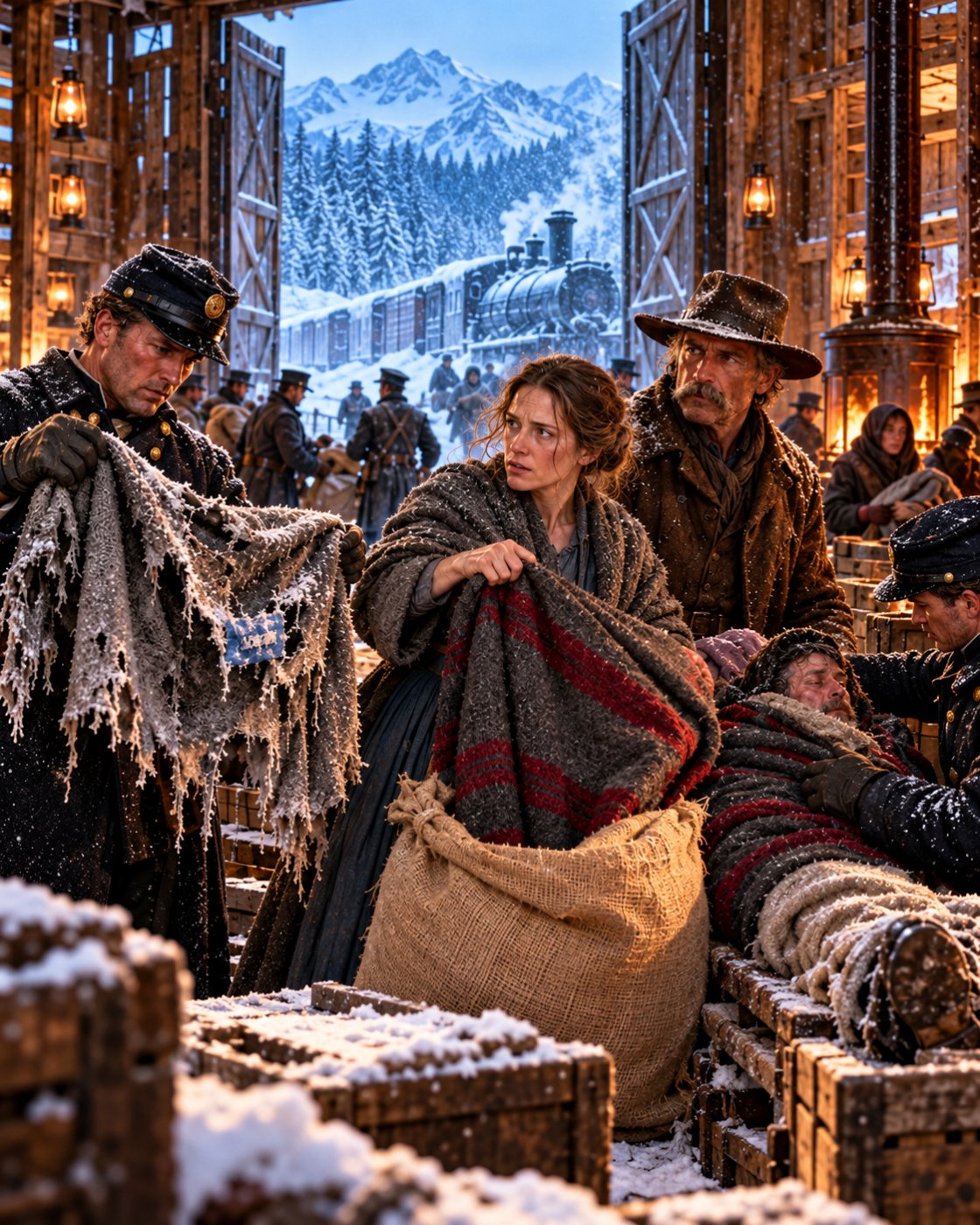
Inside a long warehouse, passengers, railroad men and twenty soldiers huddled around two stoves.
Half of them lay on the floor under Ravenscroft “pure wool” blankets with the blue label.
Melting snow had soaked them.
And they were falling apart.
Tearing into long gray strips in people’s hands. Shedding fluff like lint.
One soldier with blue lips was trying to hold the pieces together over his shoulders.
Dessa set down her bundle. And started opening sacks.
They worked until dawn.
Person to person, wrapping them in thick gray wool with crimson ends.
One by one, the shaking stopped.
A man who’d lost feeling in his hands wept when the warmth came back.
By the stove stood a young army captain with a hard face. Edmund Rhodes. The fort’s supply officer.
He picked up one of Dessa’s blankets. Then a torn rag of Ravenscroft cloth from the floor.
He held them side by side.
“Who made these?” he asked quietly.
Dessa told him.
He wrote her name in his notebook. And said nothing else. 📝
When the snow melted in March, the truth lay bare.
Three out of every four cattle in Wyoming were dead.
Millionaires from October were writing desperate letters to their creditors.
At Lone Cedar, Ned counted the survivors twice to be sure.
Three hundred and ten. Out of three thousand.
Then, on March 12th, Captain Rhodes rode into Cedar Fork with soldiers and two U.S. marshals.
He announced a public test of the army’s winter blankets. In the town square. At noon.
The whole town came.
Two tables under the courthouse clock. Barrels of ice water.
On one table, Ravenscroft blankets from the very shipment sent to the fort.
On the other, six of Dessa’s. Gray. Crimson-banded.
Hamilton Ravenscroft stood up front in a black coat. Winthrop beside him. Their lawyer, Everett Sutter, clutching a folder.
Silas stood at the back. Dessa beside him, pale as the courthouse wall. 😰
Rhodes dunked one of each in ice water. Held them under until the bubbles stopped.
Then two soldiers grabbed the ends and pulled.
The Ravenscroft blanket ripped apart with a soft, wet sound. Gray fluff drifted onto the cobblestones.
Dessa’s blanket stretched. Held. And sprang right back.
A murmur swept the crowd.
He tested five more of each. Same result every time.
“A relief detail nearly froze at Pole Creek,” Rhodes said, “under twenty thousand dollars’ worth of army blankets. I’m starting to understand why.”
The lawyer jumped in. “This proves nothing! The officer’s relying on a woman of questionable reputation!”
Then Winthrop shouted for everyone to hear.
“She isn’t even Mrs. Crane! Her name is Odessa Finley! She’s wanted in Massachusetts for stealing from our mill! Marshals, arrest her!”
Gasps. Every head turned. 😱
Dessa stepped out of the crowd.
She walked slowly across the cobblestones with a leather satchel and stopped at the table.
Her voice shook only once.
“Mr. Ravenscroft is right. My name was Finley. I took a book from the Lowell mill.”
She laid it on the table. Black cloth. Brass clasp.
“It holds the true makeup of every army blanket that mill made for a full year. With samples. I took it because it was the only proof they were selling rags to the United States Army as pure wool.”
Captain Rhodes opened it.
The square was so silent his boots on the stone sounded like drums.
He ran a finger down the columns.
Then compared the lot number to the label he’d cut from a Ravenscroft blanket.
A perfect match.
And beside it, in pencil: 40 parts wool. 60 parts rag. Sold as pure.
He looked up slowly at Hamilton Ravenscroft.
“It’s a forgery!” the lawyer cried.
Rhodes calmly slit the edge of a Ravenscroft blanket with his knife. Pulled out a handful of fiber.
Short. Gray. Full of cotton thread.
He held it up to the light.
It fell to pieces between his fingers. 😳
Winthrop lunged for the book.
A marshal caught him by the collar.
The other marshal stepped forward with handcuffs.
Hamilton Ravenscroft didn’t move.
For the first time in thirty years, he had no answer.
That warm, fatherly smile slid off his face like water off glass.
Then Silas walked through the crowd.
He stopped a few feet from the old man.
“My mother’s name was Margaret Brandt,” he said evenly. “She wove gray blankets with a red band at each end. Your store drove her out of business in 1868. With blankets just like those.”
A thin, bent figure stepped from the crowd and took off his hat.
Eustace Pike.
“I knew her,” the old man said, voice trembling. “She was an honest woman.” 😭
By April, the story was in newspapers from Cheyenne to New York.
A federal grand jury indicted Winthrop and six company officers for defrauding the United States.
The lawyer quit. The Ravenscroft Bank collapsed.
The new owners sold Silas’s mortgage to a fair lender in Denver.
The Massachusetts court reviewed the evidence and dropped the warrant against Dessa.
Hamilton Ravenscroft moved quietly back East.
And the store in Cedar Fork was sold to a man who stocked honest goods.
On April first, Captain Rhodes signed a contract with Lone Cedar Ranch.
Two thousand four hundred wool blankets. Seven-fifty apiece.
Eighteen thousand dollars.
That night, Silas did the math at the kitchen table.
Three hundred and ten cattle at fifteen dollars a head. Under five thousand.
Against eighteen thousand on Dessa’s loom.
He closed the ledger.
“Appears the blankets beat the cattle,” he said mildly. “I’ve never been so glad to lose in my life.” 😂
They started the Lone Cedar Woolen Company that spring.
Equal partners. A handshake and a signed paper.
Old Pike drove all four hundred sheep down to the green creek pasture. He moved into a snug new cabin by the barn.
The wives of ranchers who’d lost everything came to learn spinning and weaving. And earn real wages.
By summer, six looms hummed in the old bunkhouse. You could hear them from the road.
Silas opened his mother’s room for good.
He carried her photograph to the bunkhouse and hung it above the first loom.
The stern Scottish woman in the plaid shawl.
Dessa swore she looked like she was almost smiling. 🥹
That summer, Dessa finished one special blanket.
On the old Scottish loom. From Margaret’s yellowed pattern card.
Gray. With a band of crimson at each end.
She folded it on the arm of Silas’s porch chair. And didn’t say a word.
He found it at sunset.
He sat with it across his knees for a long, long time.
When Dessa came out with two cups of coffee, he didn’t look up.
“Ma’s last blanket,” he said hoarsely. “Finished.”
“Your blanket,” Dessa said softly. “She’d want you to be warm.”
He looked up at her then.
The silent man with a face like a closed gate.
And for the first time, the gate was wide open.
“Sit with me a while, Dessa?”
She sat.
He spread half the blanket over her knees.
And they watched the sun go down over the green hills. Together. ❤️
Silas Brandt once owned three thousand cattle and a hatred he couldn’t explain.
Late in life, he learned the truth.
What you throw away might be the very thing that keeps someone else warm.
A broken loom waited fifteen years in the dark for somebody to see its worth.
It just took a widow brave enough to pick it up. 🌄
✨ The world will always tell you what’s valuable, and it’s often wrong. It takes real courage to pick up what everyone else threw away.
💬 Have you ever found real value in something everyone else called worthless? Tell me in the comments!