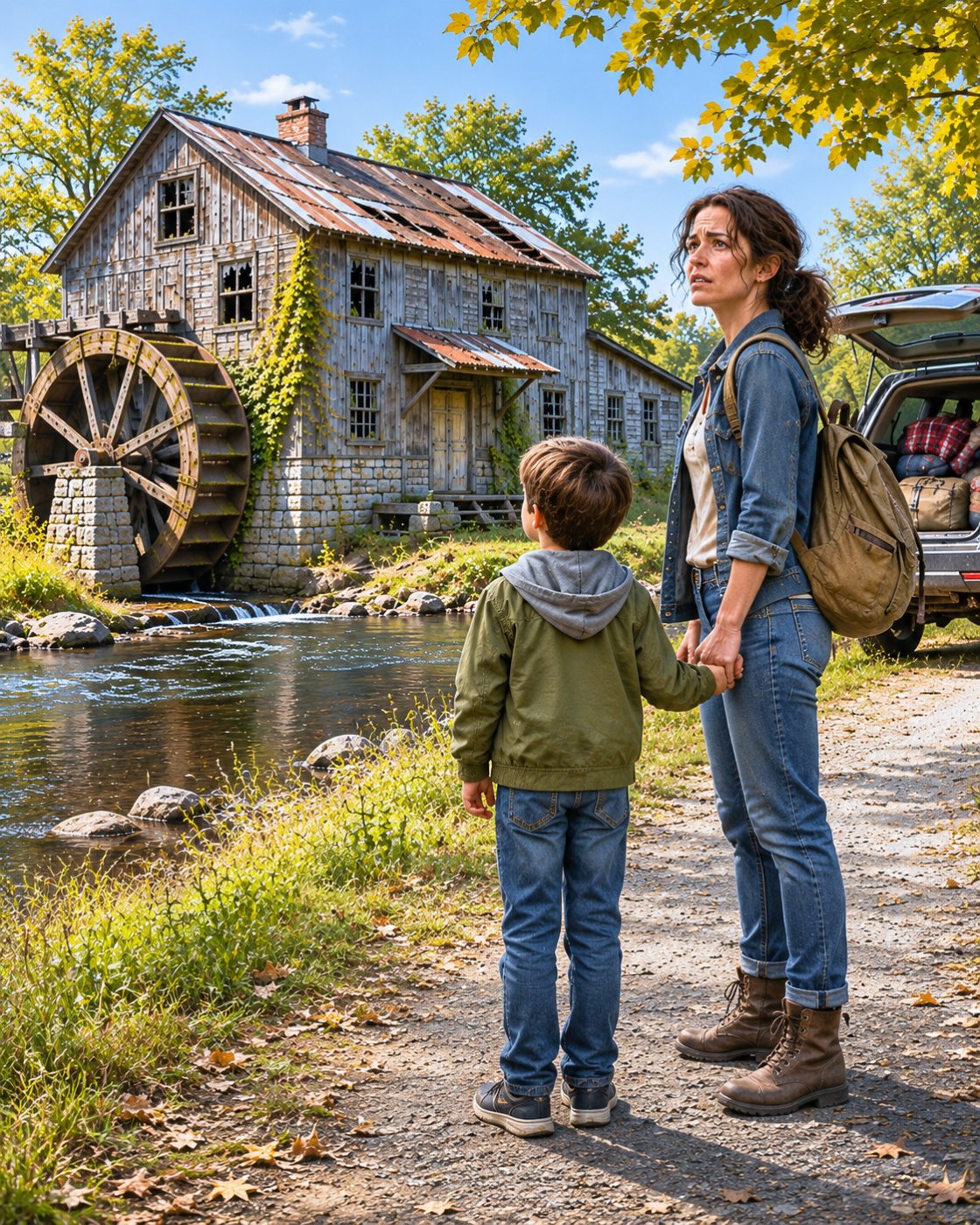
Part 3 🏡
Walter shined his flashlight down the stairs.
Laurel held her breath, bracing for the worst.
At the bottom was a small underground room lined with metal shelves.
There were no bones and no chains.
There were only boxes. Dozens of them.
Laurel opened the nearest one.
Inside were old photographs, handwritten agreements, survey maps and deeds. There were envelopes tied with faded string.
Another box held records labeled with family names, names she’d seen on mailboxes all over the county.
Walter picked up a document. Then another. His face changed.
“These are shared water agreements.”
“What does that mean?”
He looked around at the shelves.
“It means this room may not be about one missing girl. It may be about an entire community.”
Then Laurel saw a small metal box pushed under the lowest shelf.
Two words were written across the dusty lid.
Miriam Vance.
Her hands shook as she opened it.
Inside was a photograph of Miriam. She wasn’t nine years old in it.
She was a young woman. Grown up.
Alive.
Laurel’s knees went weak.
Behind the photo was a letter addressed to a daughter. Beneath it was a handwritten family record.
Laurel read Miriam’s name. Then her daughter’s name.
Then the name of Laurel’s own mother.
She stopped breathing.
“Laurel?” Walter said gently.
She read it again. There was no mistake.
The little girl reported missing in 1968 had survived. She grew up, became a mother, and later a grandmother.
Laurel sank onto the concrete step.
“Miriam Vance,” she whispered.
She looked at the photo again, at that same small dimple.
“She was my grandmother.” 😭
Somewhere above them, metal shifted.
Clang.
For the first time, the sound didn’t scare her.
Whatever was hidden under this mill wasn’t calling her toward a ghost.
It was calling her toward a history someone had tried very hard to erase.
For two days, Laurel barely left that room.
Walter helped her sort through everything while Eli colored upstairs beside an old battery radio.
Piece by piece, Miriam’s story came together.
In 1968, Miriam’s family belonged to a cooperative of small farmers. They shared irrigation channels, wells, storage barns and roads across each other’s land.
Then the pressure started.
According to the hidden letters, families were pushed to sign agreements they didn’t fully understand. Old deeds went missing. Water routes changed on new surveys.
Miriam’s father feared the original records would vanish forever, so he hid copies beneath the mill.
When things got worse, he quietly sent nine-year-old Miriam to live with relatives in Missouri.
The newspaper called her missing.
Her family never corrected the story. It kept her safe.
Laurel sat on the cold floor holding one of Miriam’s letters.
All those years in foster care, she’d believed she came from nowhere.
Now she knew someone had fought hard to protect the history she’d never been given.
Walter warned her not to get carried away.
“These papers aren’t magic. Some are probably worthless now.”
He held up another document.
“But some might not be.”
Several farms still used the same roads, wells and waterways named in those old agreements. If certain rights had never been legally ended, a lot of current disputes could get very complicated.
That afternoon, Walter solved the last mystery.
Behind the chamber ran an old ventilation shaft connected to the mill’s flood-warning system.
When creek pressure changed at night, a corroded metal arm shifted against a hollow pipe.
Walter pushed it by hand.
Clang.
Then the wind moved through the cracked shaft, and a low, wavering sound filled the room.
It sounded just like a woman crying.
Laurel closed her eyes and almost laughed.
Eli hadn’t heard a ghost. He’d heard the old mill breathing. 🌬️
But the real secret was still very much alive.
That evening, Conrad came back.
Laurel met him by the creek.
“I know Miriam survived. And I found the cooperative records.”
Something crossed his face. It wasn’t fear. It looked more like exhaustion.
“My grandfather spent his life cleaning up the mess those agreements created.”
“Cleaning it up?”
“You’ve read one side of a fifty-year-old fight.” He looked across the water. “My family built farms, businesses and jobs. People depend on arrangements made long before either of us was born.”
“So the records should just disappear?”
“No.” He met her eyes. “But the truth can hurt innocent people too.”
For the first time, Laurel understood him.
She didn’t agree with him. But she understood.
He wasn’t just greedy. He was protecting the world his family had handed him.
He gave her a folder. The contract. $350,000.
“What happens to these records if I sell?” she asked.
Conrad didn’t answer.
That was answer enough.
Laurel didn’t sleep that night.
The contract sat on a crate beside Eli’s makeshift bed.
Every time she looked at the number, she saw something different. A warm little house. A car that started every morning. A full fridge. A bedroom where Eli could leave his toys on the floor because they’d never have to pack them again.
Around midnight, Eli started coughing.
His forehead was warm. It wasn’t dangerous, but it was enough to fill her with fear.
She gave him children’s medicine and sat with him until his breathing slowed.
Then she stared at the contract again.
What kind of mother turns down $350,000 for boxes of old paper?
By morning, she’d made up her mind.
She folded the contract into her coat. She would call Conrad after she got Eli some breakfast.
On the drive into town, she passed an old farmhouse.
An elderly man was loading boxes into a pickup. A woman stood on the porch steps, holding a framed photo and just looking at the house.
A FOR SALE sign leaned by the mailbox.
Laurel knew that look.
It was the same way she’d stared at her apartment the morning she and Eli left. She’d been trying to memorize a place before it stopped being hers.
At the diner, she asked the waitress about them.
“Ruth and Daniel Holloway. They’ve farmed that land 46 years. Now there’s some fight over an access road and an old shared well. They’re losing it.”
Laurel stopped stirring her coffee.
“An old well?”
“And some road agreement nobody can find anymore.”
Laurel felt the folded contract in her coat like it weighed a hundred pounds.
An hour later, she was back underground.
“Walter. Anything about a Daniel Holloway?”
Twenty minutes later, he unfolded a brittle survey.
It showed a shared access road. Another paper mentioned the well.
“This doesn’t promise they’ll win anything,” Walter said.
“I know.”
“But it might be enough for their lawyer to start asking questions.”
That was enough for her.
She called Conrad.
He arrived before sunset, and she met him by the creek.
“I can’t sell.”
“You’re making a mistake. That money could change your son’s life.”
Laurel looked through the window. Eli was drawing a house with a red roof.
“My son’s life already changed.”
“You don’t owe these people anything.”
“No,” she said. “And that’s what makes it different.”
For years, she’d done everything out of fear.
She stayed quiet in foster homes, because quiet kids caused fewer problems. She trusted a man with her savings because she wanted so badly to have a family. When the eviction notice came, she packed. She slept in her car.
She survived. But survival always meant reacting to choices other people made.
This choice was hers.
“You’re choosing strangers over your own child,” Conrad said.
Her eyes flashed.
“No. I’m choosing what I want my child to learn from me.” 💪
She tore the contract once. She did it quietly, just enough to make her answer permanent.
The next morning, she and Walter took copies of the records to the Holloways’ attorney.
They promised nothing. They weren’t offering a miracle, just evidence that deserved to be looked at.
Two days later, Laurel found an envelope pushed under the mill door.
Inside was $86 in small bills and a note.
For copies, gas, lawyers, whatever helps. We don’t have much. But you shouldn’t have to do this alone.
There was no name.
Laurel sat down on the floor.
All her life, she’d believed being strong meant needing nobody.
She’d been wrong.
Eli climbed into her lap. “Why are you crying?”
“Because somebody helped us.”
He thought about it.
“Like we’re helping them?”
She held him tight. “Yes, baby. Just like that.” 🤍
Now she understood what Miriam’s family had tried to protect under that mill.
It wasn’t only land or water.
It was the belief that ordinary people have a better chance of holding on to what matters when they refuse to stand alone.
Nothing changed overnight.
There were no TV cameras and no big courtroom moment.
For months, lawyers, historians, surveyors and county officials went through everything.
Some records were too old to matter. Others were history and nothing more.
But a handful were different. They held rights that had never been legally ended, shared water agreements missing from later files, and surveys that contradicted lines people had accepted for decades.
Three property disputes were reopened.
Seven local families benefited.
One of them was the Holloways.
Their right to the old shared well had never been legally ended.
It didn’t fix everything. But it was enough for Ruth and Daniel to stay.
The day they moved their boxes back inside, Ruth drove to the mill with an apple pie.
She hugged Laurel without saying a word.
She didn’t need to. 🥧
Soon, other people started coming.
An 80-year-old farmer brought photos of irrigation channels his father had dug. A widow brought letters she’d kept in a dresser drawer for 40 years.
Families brought deeds, maps and stories that had never made it into any official file.
The mill became something Laurel never planned.
It became a place where forgotten history came home.
Then one Saturday morning, Laurel woke up to hammering.
She ran outside.
Six pickup trucks were parked by the creek.
Walter stood by the door, sipping coffee.
“What is this?”
He shrugged. “Roof leaks.”
Neighbors were replacing boards, fixing windows and reinforcing the floor.
Over the next few weeks, volunteers restored part of the old waterwheel. They built a small, warm living space inside the mill for Laurel and Eli.
And for the first time in his life, Eli had a room.
A real room.
It was so small his bed almost touched both walls. He didn’t care.
He taped drawings above his bed. One showed the mill. One showed Walter. One showed Laurel holding his hand.
Across the top, in wobbly letters, he’d written:
OUR HOME.
Laurel cried when she saw it. 😭
Soon a wooden sign went up by the road:
MILL CREEK COMMUNITY ARCHIVE
History belongs to everyone.
Conrad Halbrook never became Laurel’s friend.
But he didn’t turn out to be the monster some people expected, either.
Months later, he came to the mill alone and stood beside the turning wheel.
“My grandfather’s name is in those records,” he said.
“I know.”
“He made choices I wouldn’t have made.”
Laurel waited.
“I spent most of my life thinking that protecting what my family built meant protecting everything they did to build it.” He gave a small, tired smile. “Those aren’t the same thing.”
Laurel didn’t forgive the past on behalf of the people who had been hurt by it.
And Conrad didn’t ask her to.
He just nodded and left.
That night, Laurel tucked Eli into bed.
He looked around his tiny room.
“Mommy? Are we gonna have to leave this home too?”
The question broke something inside her.
She brushed the hair off his forehead.
For years, she’d thought home meant a deed, a locked door and money in the bank.
Now she knew better.
Home was where your story was allowed to stay. Where people noticed when your roof leaked and showed up with a hammer. Where your child could finally stop asking when you were leaving.
She kissed his forehead.
“No, sweetheart. This time, we’re home.” 🏡
Months later, Laurel woke suddenly in the dark.
She reached for her phone.
2:13 a.m.
She waited.
There was no clang and no crying.
There was only the gentle sound of water turning the restored wheel beneath them.
Across the room, Eli slept safely in his own bed.
Moonlight spilled over the old Kansas creek.
Laurel smiled and closed her eyes.
She’d bought a $50 watermill because she had nowhere else to go. She thought she was buying shelter.
Instead, she found the family history that had been taken from her, and a community she never knew she had.
And she found a place her son could finally call home. ✨
✨ A home isn’t valuable because of what it costs. It’s valuable because of who shows up for you inside it.
💬 What does “home” truly mean to you? Tell us below 👇