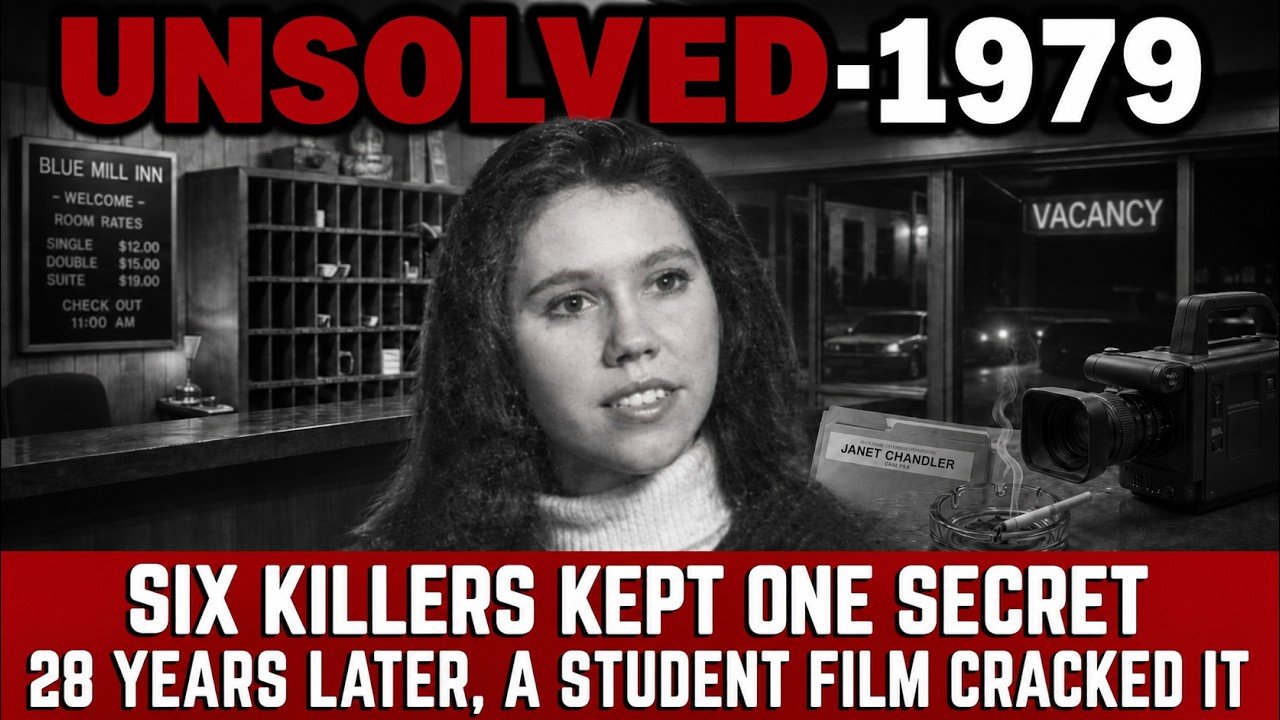
Just before 2:00 in the morning on January 31st, 1979, two security guards walked into the front office of the Blue Mill Inn in Holland, Michigan and told the overnight clerk there was a surprise party in her honor.
They blindfolded her, walked her to a car, then called the police to report a robbery.
Officers found her coat still on the chair and a Salem cigarette still burning in the ashtray.
The clerk's name was Janet Chandler, a 22-year-old Hope College music student working nights to pay for school.
What nobody knew was that her own roommate helped plan what happened next, that as many as 20 people watched, and that every one of them would stay silent for 27 years until a college film class started asking questions.
This is the story of the Michigan cold case that sat frozen for nearly three decades and the classroom that cracked it open.
Muskegon, Michigan, a small industrial city on the eastern shore of Lake Michigan, where the winters hit hard and the summers fill up with fishing boats and county fairs.
The kind of town where generations work the same factories and worship in the same churches and know each other's families by name.
Janet Marie Chandler was born there in May of 1956, the only daughter in a family of three children.
Her brothers were James Jr.
, who everyone called Jim, and Dennis, the youngest.
Their father, Jim Sr.
, worked steady hours and kept the family anchored.
Their mother, Glenna, kept the house, kept the faith, and kept a close watch on her children.
The Chandlers were a devout Christian family, the kind of household where Sunday meant church, where the Bible sat open on the kitchen table, and where their daughter was not allowed to attend sleepovers if there was even a chance that alcohol might be present.
Janet sang.
That was the thing about her people remembered first before anything else, before any detail about the case or the crime or the investigation.
She had a mezzo-soprano voice that her father said could stop people in the street.
And he was not exaggerating.
In Muskegon, neighbors would gather on the sidewalk outside the Chandler family's living room window just to listen to her practice.
Not because she was performing for them.
Not because anyone had told them a concert was happening.
She was just rehearsing.
Doing her scales, running through hymns for the church choir, working on pieces for school.
And people would stand outside in the Michigan air, sometimes in the cold, and listen.
They heard that voice coming through the glass, and they stayed.
She went on church missions as a girl.
She worked at a daycare center.
She sang in the choir every Sunday.
And she carried a dream that was specific enough to prove she had thought about it seriously.
She wanted to teach music at a private Christian school and perform in theater, maybe even opera.
She wrote in her Hope College application that her first goal was to acquire what God wanted for her.
And then she planned to earn a bachelor's degree in music vocal education followed by a master's degree.
That application was the kind of thing a young person writes when they still believe the world will cooperate with their plans.
Janet's mother Glena kept that application in a box of Janet's college belongings for nearly 20 years without ever opening it.
The pain of looking through her daughter's things was too sharp, too immediate, even after a decade.
And then another decade had passed.
When Glena finally did find the courage to open that box, she discovered the application alongside Janet's heavily underlined Bible and a school notebook with what may have been the last thing her daughter ever wrote.
It was a question about faith.
When was Paul saved? When the Lord spoke to him to go or when he obeyed God and went.
>> >> Janet had been discussing that question with her mother on the phone just days before she died.
Janet started at Muskegon Community College in 1974 and later transferred to Hope College, a small liberal arts school affiliated with the Reformed Church in America, located about an hour south of Muskegon in Holland, Michigan.
Holland was the kind of place that looked like it had been lifted from a postcard.
A Dutch heritage town of roughly 25,000 people, famous for its annual Tulip Time Festival and the 6 million tulips that bloomed along its streets >> >> every spring.
It was the sort of community where police would fine you $50 for picking a tulip from a public garden.
The downtown had brick storefronts and church steeples and a windmill that tourists photographed from across the river.
Hope College sat in the middle of that quaint, tidy, almost impossibly safe-looking town.
A dry campus of around 2,300 students where parents felt comfortable sending their children because Holland itself seemed like a place where nothing truly bad could happen.
By the fall of 1978, Janet was a senior music major.
She needed money to finish her degree and in August she took a job working the overnight shift at the Blue Mill Inn, a motel on US 31 near 16th Street on the edge of town.
Her parents were against it from the beginning.
Jim Chandler tried hard to talk her out of it.
Even then, he would later say, a night clerk job at a motel was not the safest place to be.
Parents have instincts about these things.
Sometimes those instincts are right.
Janet took the job anyway.
She was 22.
>> >> She was independent.
She needed the money.
And the Blue Mill was just a motel.
What could go wrong? She walked into a situation that nobody at Hope College could have imagined.
That fall, workers at the Chemtron Corporation paint plant in Holland had gone on strike.
It was a bitter dispute.
The company brought in replacement workers to keep production moving.
And the Teamsters Union responded by sending experienced picketers from Detroit to put pressure on the scabs crossing the line.
To protect the replacement workers and maintain operations, Chemstrand hired the Wackenhut Corporation, a private security firm with a Detroit-based operation to provide around 80 armed guards.
Those guards needed somewhere to stay, and they were housed at the Blue Mill Inn.
Dozens of them filling the rooms, taking over the common areas, turning a roadside motel into a barracks.
The motel transformed.
What had been an ordinary highway stop where families booked rooms during tulip time became, in the words of Michigan State Police Lieutenant John Slink, a den of iniquity.
A wild bunch of unsupervised people living together with no oversight and no accountability.
The guards worked 12-hour shifts escorting strike breakers through picket lines where union men threw spikes under tires >> >> and screamed threats at anyone who crossed.
After their shifts, they drank.
They drank at the tap room, the bar located right next door to the motel.
They partied in their rooms and in the parking lot.
They fought with each other and with locals.
And they mixed freely with the young women who worked the motel's front desk and cleaned its rooms.
Janet was one of those young women working at the Blue Mill.
So was Laurie Ann Swank, who was both Janet's roommate at a nearby apartment in Holland and her night supervisor at the motel.
Swank was a few years older and had been at the Blue Mill longer.
The two women knew the same guards, socialized in the same loose circles that had formed around the motel, >> >> and crossed paths regularly with a man named Arthur Carl Paiva.
Paiva was the Wackenhut site supervisor, a Muskegon man in his late 20s with a temper and a need to be in control.
Among the guards, his word was law.
Swank had developed feelings for him.
And when Swank learned that Janet had been involved with other guards at the motel, a fact that in any normal circumstance would have been none of Swank's business, she did not keep it to herself.
She went to Paiva.
She fed him details about Janet's personal life, details carefully chosen to provoke him, to make him angry, to stoke his jealousy into something dangerous.
Paiva's reaction, according to Swank's later testimony, was immediate.
He called Janet a [ __ ] and said he would take care of it.
The guards would teach her a lesson, he said.
They would bring her down a few notches.
That conversation between Swank and Paiva was the beginning of everything that followed.
Swank did not warn Janet.
She did not call the police.
She did not walk away from Paiva or from the plan that was forming.
She helped him make it happen.
On the night of January 30th, 1979, Janet Chandler arrived at the Blue Mill Inn to begin her overnight shift.
Outside, Western Michigan was locked in one of its harshest winters in years.
The 1978 to 1979 season had brought record cold and heavy snow that collapsed roofs in Grand Rapids and buried cars along the Lake Michigan shoreline.
The highways were sheeted with ice.
The wind coming off the lake cut through layers of clothing like they weren't there.
Snow was piled along the sides of Interstate 196 in walls taller than a person.
Inside the motel office, Janet settled in for the night.
She hung her coat over the back of her chair.
She lit a Salem cigarette.
And she had no idea that the people she lived with, worked with, and trusted were not going to let her see the morning.
If this is your first time on this channel, we tell stories like Janet's every week.
The cases everyone thought would stay buried.
Subscribe so you don't miss the next one.
Just before 2:00 in the morning on January 31st, two Wackenhut guards named James Nelson, who went by the nickname Bubba, and Robert Lynch walked into the front office and told Janet that a surprise party was waiting for her.
"Come on," they said, "everyone's there.
It'll be fun".
They blindfolded her with gauze sealed over her eyes with duct tape.
They put her in handcuffs and they walked her out of the motel office through the snow and into a waiting car.
From the balcony above the office, other guards and motel staff watched the whole thing happen.
Anthony Williams was up there.
Others stood beside him.
They watched Janet Chandler blindfolded and handcuffed be placed into the backseat of a vehicle and driven away from the motel.
And not a single person standing on that balcony said a word.
Nobody shouted down.
Nobody ran to a phone.
Nobody moved.
Then Lynch went back inside and picked up the motel telephone.
He dialed the Holland Police Department and reported a robbery.
He told the dispatcher that another guest at the motel had overheard a deep-voiced man and a woman saying, "Please don't take all the money, sir".
The performance was rehearsed.
When Detective Jeff Floor analyzed that 911 recording years later, he had two words for it, "Staged.
No emotion".
It sounded like a man reading from a script because that was exactly what it was.
When officers arrived at the Blue Mill Inn, they found the office door unlocked.
About $500 was missing from the register.
Janet's coat was still draped over the back of the chair and a lit Salem cigarette was still smoldering in the ashtray.
The thin curl of smoke rising into the empty room.
Nobody was behind the desk.
Two sets of footprints led through the snow outside to tire tracks that curved toward the highway and disappeared.
That smoldering cigarette would stay in the minds of investigators for decades.
Janet had been sitting at that desk only minutes before officers arrived.
She had been alive.
She had been close.
And she was already gone.
Janet had been taken to a guest house on the grounds of the Chemtron plant, a split-level home overlooking Lake Macatawa, that Carl Pierson had commandeered for his personal use.
Inside that house, between 15 and 25 people were gathered.
Guards in their off hours, motel staff who had come from the Blue Mill.
At least six women who worked at the motel, including Laurie Swank.
They were drinking.
Some of them knew exactly what was going to happen.
Others may not have fully understood until it started.
What happened to Janet Chandler over the hours she was held inside that house does not need to be described in graphic detail to understand its horror.
She was bound, blindfolded, and assaulted by multiple men while the others in the room watched, drank, and in some cases cheered.
Laurie Swank was there.
She watched.
She would later admit in her confession that she cheered it on.
Pierson directed what was happening and controlled the room.
He ordered a guard named Ronald Weirick to photograph the assault.
Not because Pierson wanted a record of the crime, but because he wanted insurance.
Those photographs would guarantee that everyone present kept their mouths shut.
If you talk, the photos come out and you go down with the rest of us.
Janet was strangled with a belt.
After she was dead, several of the guards cleaned her body.
>> >> Then Robert Lynch loaded her into a vehicle and drove roughly 40 miles south on Interstate 196.
He pulled off the highway at a wooded turnaround in Van Buren County, between Holland and South Haven, and left her in the snow.
He drove back to the Blue Mill Inn and said nothing.
Around 1:30 in the morning on February 1st, 1979, a snow plow driver working the highway median near that turnaround noticed fresh tire tracks in the snow where no vehicle should have been.
He climbed down from the cab of his truck and followed the tracks.
What he found stopped him where he stood.
An arm and part of a torso protruding from the ground.
The only visible parts of a young woman's body half buried in a snowbank off the side of Interstate 196.
Janet Chandler had been found.
Detective Jim Fairbanks of the Holland Police Department was one of the first officers called to the scene.
The investigation that followed was massive by the standards of a small Michigan Police Department.
Every guest registered at the Blue Mill Inn was identified and interrogated.
Janet's friends, family, professors, and classmates at Hope College were interviewed.
Guards at the motel were questioned.
Polygraph tests were administered to anyone police considered a person of interest.
>> >> Over a thousand pages of investigative notes were compiled.
Tips were followed.
Theories were developed and discarded.
The detectives worked the case hard and for a while they believed they would solve it.
They did not.
The investigation had a fundamental problem that the detectives of 1979 could not overcome.
There was no DNA technology.
There were no surveillance cameras at the Blue Mill Inn.
There were no cell phone records to trace.
The physical evidence from the crime scene was limited.
And the forensic tools that would have made it useful had not been invented yet.
The case would have to be solved by witnesses.
And the witnesses were lying.
James Nelson, the guard who had walked Janet out of the motel office in handcuffs, went to the police voluntarily.
He told detectives that he had been on the phone with Janet around the time of the abduction and had overheard parts of the robbery.
He positioned himself as a cooperating witness.
The concerned guard who had tried to help.
Who had heard something wrong and wanted to do the right thing.
The police treated him as a valuable source.
They gave him access.
They shared information.
And the entire time, Nelson was one of the men who had blindfolded her and put her in the car.
He played the helpful bystander while the detectives were looking for the very person standing in front of them.
Holland was shaken.
Hope College held a memorial service for Janet.
Her professors and classmates tried to process the fact that a woman they had sat next to in music classes had been murdered in the town they all thought of as safe.
The local newspaper ran stories for weeks.
Police fielded tips from concerned citizens who had seen suspicious cars, heard arguments, and noticed strangers.
None of them led anywhere.
Meanwhile, the Chemetron strike ended roughly 2 weeks after Janet's murder.
And when it ended, the guards left.
80 men from out of state packed their bags and scattered back across the country to Michigan, West Virginia, Wisconsin, Pennsylvania, and beyond.
>> >> Many of them had not been fully questioned.
Some of them had not been questioned at all.
Holland police could request interviews across state lines, but the manpower and budget required to track down 80 transient security guards in an era before digital records was enormous.
There was no national database of addresses, no email, no internet search.
Finding these men meant cold calls to other police departments, letters to forwarding addresses, and trips that a small town department could not afford.
The window for catching them while the evidence was fresh and the memories were vivid closed within weeks.
Retired Holland Police Chief Charles Lindstrom would later acknowledge that investigators were aware of Janet's connections to several of the guards at the Blue Mill.
They knew there were relationships.
They suspected involvement.
They lacked the evidence to charge anyone.
And once those men drove out of Michigan, the distance between suspicion and proof became a canyon that the 1979 investigation could not cross.
The case went cold.
For the next 24 years, a photograph of Janet Chandler was pinned to the homicide bulletin board at the Holland Police Department.
The edges of the photo curled with age.
The tape holding it in place yellowed.
Detectives came and went.
Some retired, some transferred, but nobody took that photograph down.
It stayed on the board year after year, a silent reminder of the case they could not close.
Detective Fairbanks, who had stood in the snow on the side of Interstate 196, looking at the body of a 22-year-old music student, carried a conviction about this case that he repeated to every officer who would listen.
"Somebody knows something," he said.
"Somebody always knows something".
He was right.
At least 20 people knew exactly what had happened to Janet Chandler, and for more than a quarter century, every single one of them kept their mouths shut.
If you think this case should never have gone cold, hit the like button.
It helps more people find Janet's story.
The silence held for reasons that were both simple and sickening.
The people who had been inside that guest house on the night of January 31st were bound together by three forces that reinforced each other year after year.
The first was fear.
Carl Piiva had made it clear, both during and after the murder, that anyone who talked would receive the same treatment Janet had received.
The women who had witnessed the assault were told directly that they would be next.
Cheryl Ruiz, who had been a motel maid at the Blue Mill, lived with that threat hanging over her for decades.
Diane Marsman, another maid who had been present, carried it, too.
Patty Ward, who had been Piiva's girlfriend, was forced to provide a false alibi, and told what would happen if she didn't.
The second force was the photographs.
Paiva had ordered Ronald Werrick to take an entire roll of film during the assault, 24 exposures.
Those photos were never recovered by police, but their existence functioned as a dead man's switch.
Everyone in the room was implicated in those images.
If anyone went to the authorities, the photographs could surface, >> >> and the person who talked would be identified as a participant, not just a witness.
The blackmail worked because the threat was mutual.
You can't confess without confessing.
The third force was guilt itself.
Nearly everyone who had been present that night was complicit in some way.
Some had participated directly.
Others had watched.
Others had stood by and done nothing while a young woman was killed.
Going to the police meant admitting what they had seen and failed to stop.
It meant explaining to their families, their communities, their children why they had stood in a room and let it happen.
Years later, when investigators finally tracked down the women who had been present, they asked the question that everyone watching this story would ask.
Why didn't you call the police? Cheryl Ruiz answered on camera for Dateline NBC.
"They're not going to believe us," she said.
Diane Marsman put it differently.
"That fear grips you," she said.
"It just grips you".
Detective Floor, who would spend years working this case, had a colder assessment.
"Did any one of them try to warn Janet?" he asked.
Not a one of them.
There was a fourth factor, less visible but just as corrosive.
The corporate culture of the Wackenhut Corporation itself offered no accountability.
One former guard, Glenn Johnson, later told investigators about an internal motto that circulated among Wackenhut employees, "I know nothing, see nothing, and speak only in kind words".
Whether that phrase was official company policy or just the informal code of conduct among the guards, it described the culture perfectly.
These were men hired to maintain order at a strike, not to answer questions about what they did after their shifts ended.
>> >> When the strike was over, Wackenhut moved on.
The company did not follow up on what had happened in Holland.
It did not investigate.
It did not ask.
And so the years passed, one by one, and then decade by decade, the people who knew what had happened to Janet Chandler built new lives as far from Holland as they could get.
Piva stayed close in Muskegon, where he had grown up.
Nelson moved to Rand, West Virginia.
Williams settled in Boscobel, Wisconsin.
Parker went to Powelton, West Virginia.
Lynch stayed in Michigan, in the small town of Three Oaks.
Swank relocated all the way to Nescopeck, Pennsylvania.
They got jobs.
Some of them married.
Some had children of their own.
They coached little league and went to parent-teacher conferences, >> >> and sat in church pews on Sundays, and embedded themselves in the fabric of communities that had no idea what had happened in a split-level house overlooking Lake Macatawa on a January night in 1979.
They carried the secret the way a person carries a stone in a pocket.
Always there.
Always heavy.
Never mentioned.
In Muskegon, Jim and Glenna Chandler lived with the absence.
They buried their only daughter at Lakeside Cemetery, and tried to hold her memory in a world that was slowly, steadily forgetting.
They could not listen to Janet's recordings.
The sound of her voice, the mezzo-soprano that had once pulled neighbors to the window, was now a sound that pulled them into a grief they could not survive hearing.
They kept her belongings sealed in that box.
They prayed.
>> >> They waited for a phone call from the Holland Police Department that never came.
For 24 years, they waited.
In the spring of 2003, something shifted.
>> >> It did not happen in a police station.
It did not happen in a courtroom or a crime lab.
It happened in a classroom at Hope College.
David Schock was an associate professor of communication at Hope.
The kind of teacher who believed that a documentary class should teach students to care about something real, >> >> not just how to operate a camera.
In the spring of that year, he brought a group of students to the Holland Police Department for a routine class visit, a lesson in how reporters and journalists build working relationships with law enforcement.
The students met the department's public information officer, a retiring captain named Bob De Vries.
De Vries had spent decades on the Holland force and was wrapping up his career.
Schock asked him one question that changed the trajectory of the case, the careers of the detectives who would follow, >> >> and the lives of the Chandler family.
"Out of your whole career in policing," he said, "which was the case that got away? Which one do you still think about?" De Vries did not hesitate.
He did not pause or shuffle through mental files or weigh his options.
He answered instantly.
"Janet Chandler," he said.
Schock would later recall that moment with a kind of reverence.
"He might as well have carved that on my heart," he said.
Janet Chandler, a Hope College student, a music major, murdered in 1979, 24 years earlier.
Case unsolved.
File sitting in a cabinet at the same police department where Schock was standing.
And here was David Schock, a professor at the same college where Janet had studied and practiced and dreamed, hearing her name for the first time.
The connection was almost too perfect.
The irony was not lost on him, and it would become the emotional engine of everything that followed.
Janet was a Hope student.
Hope students were about to become the reason her killers were caught.
That fall, Schock organized a documentary film class around the Chandler case.
He recruited eight juniors.
Their names were Allam Alamov, who had traveled from Tajikistan to attend Hope College, Tyler Beisler from Auburn, Michigan, Sarah Hartman from Richmond, Indiana, Wes Holland-Oner from Akron, Ohio, Jonathan Johnson from Fremont, Michigan, >> >> Amber Ross from Schiller Park, Illinois, Amy Schluescheler from Lapeer, Michigan, and Kyle Shepherd from Oak Forest, Illinois.
>> >> Working with them was Phil Blau, a Hope College staff videographer who had handled the technical side of production.
Before they picked up a camera, Schock sat them down and gave them an honest expectation.
"I don't want you to think that we are going to solve this murder," he told them.
"That was not the purpose.
The goal was to tell Janet's story, to put her name back into the community's memory, to give the Chandler family a chance to speak on camera about the daughter they had lost.
And maybe, if the film reached the right ears, to shake loose a lead that police could follow up on.
Maybe".
The students obtained the Chandler family's consent and drove to Muskegon.
Meeting Jim and Glenna Chandler was the moment the project stopped being an academic assignment and became personal in a way that none of them had anticipated.
They sat in the Chandler family's living room, the same room where neighbors had once stood on the sidewalk outside to hear Janet sing, and they listened to two parents who had been carrying this weight for 24 years without relief.
Glenna showed them Janet's Bible with its underlined passages.
She showed them the college application with its earnest statement about God's plan.
Jim talked about trying to convince Janet not to take the overnight shift at the Blue Mill.
His voice broke when he described the last time he saw her alive.
Dennis, Janet's younger brother, spoke about his sister's faith with quiet certainty.
"She definitely knew where she was heading, he told the students.
She believed in God.
The students also began retracing the geography of the case.
They drove to the Blue Mill Inn on US-31, which was still standing, still operating under a different name.
They walked the same hallway Janet had walked to get to the front desk.
They looked at the same parking lot where two sets of footprints had led to tire tracks in the snow on a January night 24 years earlier.
They drove the stretch of Interstate 196 between Holland and Van Buren County, the same highway Robert Lynch had driven in the dark with Janet's body in the car.
For students who had grown up watching true crime on television, being physically present at the locations where a real murder had happened >> >> was a different experience entirely.
This was not a case study in a textbook.
This was real ground, real cold, a real woman who had been their age when she died.
They tracked down the detectives who had worked the case in 1979.
They found Jim Fairbanks, the officer who had been first on the scene when Janet's body was discovered along Interstate 196.
Fairbanks was retired now, older, his career behind him.
But his conviction about the case had not weakened by a single degree.
He repeated the line he had been carrying for a quarter century, the line that would become the thesis of the entire documentary and eventually the motto of a cold case organization.
Somebody knows something.
Somebody always knows something.
The finished film was called Who Killed Janet Chandler.
It ran about 80 minutes.
The premiere was held at the Knickerbocker Theatre in downtown Holland on January 28th, 2004.
With additional screenings on the 29th and 30th.
The theater filled with Holland residents, Hope College staff and students, law enforcement officers, and members of the Chandler family.
Shock walked into that room knowing exactly what the film contained and having no idea how the community would respond.
Holland had lived with this case as an open wound for 25 years.
Some of the people in that audience had known Janet.
Some of them had stayed at the Blue Mill.
Showing the film in that town felt like reaching into something painful and pulling it into the light.
The film ended.
The screen went dark.
And the theater went completely silent.
Schock later described walking what felt like the longest aisle of his life from the projection area toward the front of the room.
He could not read the silence.
He did not know if it was shock, or anger, or grief, or rejection.
Then the lights came up.
And it broke.
Tears and applause.
Lots of tears.
Three days later, on February 1st, 2004, the documentary aired on WGVU TV, the public broadcasting station in Grand Rapids.
The airtime was 1:00 in the morning.
That was not an accident, and it was not a bad time slot.
It was deliberate.
The broadcast was timed to air 25 years to the hour after the snowplow driver on Interstate 196 had discovered Janet Chandler's body in the snow.
Jim Chandler watched the broadcast and said something that would prove prophetic.
"Nothing would have been done," he said, "without somebody like David Schock and his class taking this on as a project".
Within weeks, the film had done exactly what Schock had hoped it might.
>> >> It touched the conscience of a community.
And it reached the desk of Holland Police Chief John Kruithoff, who watched it, pulled the old Chandler files from storage, and made a phone call to the Michigan State Police.
In April of 2004, the two agencies announced the formation of a joint cold case team dedicated to solving the murder of Janet Chandler.
The team was led by Michigan State Police Lieutenant John Slank, who ran the Southwestern Michigan Cold Case Unit.
Under Slink were detectives David Van Lopik, who became the lead investigator on the case, Mike Jaffrey, and Jeff Floor.
Floor was a polygraph examiner and an interrogation specialist whose colleagues had given him a nickname.
They called him the closer.
From the Holland Police Department, detectives Rob Berowski and Roger Van Leer joined the effort.
Four of these investigators would work the Chandler case exclusively for Chandler case exclusively for the next 2 years.
And over that time, they would travel to 18 states and conduct more than 300 interviews.
Slink understood something about this case that set it apart from most cold investigations.
This was not a case where DNA evidence had been sitting in a storage room waiting for technology to catch up.
There was no physical evidence that could be retested with modern tools.
The only thing that could solve the murder of Janet Chandler was human beings deciding after 25 years of silence to talk.
And to make that happen, the public needed to know the case was active again.
Slink went to the press deliberately.
"The more we show this case in the media," he told reporters, "the more optimistic I am that we can solve it".
It was a calculated move.
Every news story, every broadcast, every mention of Janet Chandler's name was another crack in the wall of silence.
They also had one asset that no detective in 1979 could have imagined using, the documentary itself.
Copies of the film became standard equipment in every interview bag.
Jaffrey later estimated that the tape was probably played in 40 states at all hours of the day and night.
>> >> Detectives carried it to every doorstep, every hotel room interrogation, every sit-down with a former Wackenhut guard or Blue Mill employee who had scattered across America decades earlier.
The film was not just context for the investigation.
It was an emotional tool.
It put Jim Chandler's face on a television screen, >> >> tears running down his cheeks, asking why.
It put Glenna's grief in front of people who had been avoiding it for 25 years.
And it made the lie harder to maintain.
The first real break came from a man named Glenn Johnson, a former Wackenhut guard who had been tracked down in Minneapolis.
Johnson had not been at the guesthouse on the night of the murder, but he had worked alongside the men who were.
Over the years, he had heard things, rumors, pieces of stories that did not add up to innocence.
He gave the cold case team a name they had not been focused on.
Robert Lynch.
Lynch was the man who had dialed Holland police on the night of January 31st, 1979, to report a robbery at the Blue Mill Inn.
He was the man who had delivered the flat, emotionless performance on the 911 tape that Floor would later dissect and call staged.
Lynch was still in Michigan, living in the small town of Three Oaks.
And when detectives knocked on his door, he denied everything.
Van Lopik and Floor went to work on Lynch with a patience that bordered on obsession.
Over roughly 18 separate interrogation sessions spread across many months.
The two detectives wore Lynch down one careful layer at a time.
Lynch was not a practiced criminal holding a professional wall.
He was a man who had been carrying the weight of what he had done for more than 25 years, drinking heavily, aging badly, and slowly coming apart under the pressure of a secret he could not put down and could not confess.
During one of those sessions, the detectives played the documentary.
They showed Lynch the footage of Jim Chandler breaking down on camera, an elderly father crying for his daughter, and asking why nobody had been held accountable.
They asked Lynch to watch that footage and then sit in that room and keep lying.
The lies cracked slowly.
Lynch's first admission was vague.
He described the night as a party that went haywire.
Something got out of hand, he said.
Over subsequent sessions, the vagueness gave way to specifics.
Lynch confessed to the staged abduction, the surprise party lure, the fake 911 call.
He confessed to his role in the assault.
He described driving Janet's body south on Interstate 196 in the dark, pulling off the highway at the turnaround in Van Buren County, and leaving her in the snow.
And he named the person who had helped plan everything from the The cold case team flew to Nescopeck, Pennsylvania, where Lori Ann Swank had been living for years, far from Holland, far from Hope College, far from the motel where she had shared a shift and an apartment with the woman she helped kill.
When detectives first knocked on Swank's door, she gave a performance that investigators described as grief.
She said learning about Janet's death had made her physically ill.
She expressed sympathy.
She spoke about Janet as a friend and a colleague.
She was a woman who had lost someone and never recovered, or at least that was the story she wanted the detectives to believe.
Then Jeff Floor sat down across from her.
Floor had earned his nickname across years of interrogations.
He had a method.
He watched how people breathed.
He tracked the small movements of their hands and eyes.
He listened not just to what people said, but to the gaps between what they said.
The places where the rehearsed story >> >> ran into the truth and veered away from it.
Swank's grief act had cracks.
Floor found every single one.
Under sustained questioning, the performance collapsed.
Swank admitted that she had told Paiva about Janet's personal relationships with other guards, and that she had done it to provoke him.
She admitted that she had helped plan the assault.
She admitted that she had been present inside the guest house while Janet was being held and attacked.
And she admitted, in words that landed like a verdict, that she had cheered it on.
This was Janet's roommate, her supervisor at work, the woman she had been living with.
And Swank had walked Janet into a trap, watched what happened, and then gone home and kept the secret for 27 years.
One of the Hope College students, Amy Schlossler, captured the depth of that betrayal in a sentence that still hits like a closed fist.
"How could you, as a woman, sit there and not stop it?" She literally watched her roommate die.
With Lynch's and Swank's cooperation secured, the cold case team moved to build a case that could withstand trial.
They tracked down the other witnesses who had been present.
Sheryl Ruiz came forward and described what she had seen.
Diane Marsman came forward.
>> >> Patty Ward, who had been Paiva's girlfriend, and had been coerced into providing a false alibi, finally told the truth.
Ronald Weirick, >> >> the man Paiva had ordered to photograph the assault, confirmed the blackmail scheme.
Harry Keith, who had been Lynch's roommate during the strike, produced a personal photo album from 1979 that contained images from the Blue Mill, pictures that helped investigators map out the relationships and establish the timeline.
Robert Lynch was taken into custody in February 2006 after making statements that suggested he might harm himself.
He was formally charged with first-degree murder.
On September 20th, 2006, Michigan Attorney General Mike Cox and Ottawa County Prosecutor Ronald France held a press conference at the courthouse in Grand Haven and announced first-degree murder charges against five additional people.
Arthur Carl Paiva, James Bubba Nelson, Freddy Bass Parker, Anthony Eugene Williams, and Lori Ann Swank.
That same week, law enforcement agencies across four states coordinated a simultaneous arrest operation.
Paiva was picked up in Muskegon, Michigan, just miles from the town where Janet had grown up, where her parents still lived, where her grave sat in Lakeside Cemetery.
Swank was arrested in Nescopeck, Pennsylvania.
Nelson and Parker were into custody in West Virginia.
Williams was arrested in Boscobel, Wisconsin.
The people who had scattered across the country in February 1979, confident that distance and time and silence would protect them, learned in the space of a single day that it had not.
Cox stood at the podium during the press conference and told reporters that the allegations in this case were as shocking and disturbing as anything he had encountered in his entire career.
For the Chandler family watching the news coverage from Muskegon, the press conference meant something that no press conference had ever meant to them before.
It meant someone was finally being held accountable for their daughter's death.
After 27 years of nothing, there were names and faces and handcuffs.
27 years after a motel clerk was blindfolded and walked to a car on a freezing Michigan night, the people who took her were finally in custody.
We cover one case like this every week on Cold Case Redemption.
If you want to see the ones everyone thought would stay buried, the subscribe button is right there.
The legal proceedings unfolded across the following year.
Robert Lynch pleaded guilty to second-degree murder in December 2006.
He was sentenced to 25 to 40 years in prison.
His years of heavy drinking had left him with alcohol-related dementia so severe that the prosecution ultimately decided not to call him as a witness at trial.
Lori Swank pleaded guilty to second-degree murder in January 2007 and received a sentence of 10 to 20 years.
She agreed to testify for the state.
The joint trial of the remaining four defendants, Arthur Carl Paiva, James Nelson, Freddy Parker, and Anthony Williams, began on October 16th, 2007 in Ottawa County Circuit Court in Grand Haven, Michigan.
The presiding judge was Edward R.
Post.
The lead prosecutor was Assistant Attorney General Donna Pendergast, who had been assigned the case by the Attorney General's Office.
Pendergast faced a problem that would have sunk many prosecutions.
There was no DNA evidence.
Nothing physical had survived 28 years in a form that could be presented to a jury.
Pendergast told Dateline NBC directly that they had no DNA and no samples that could be compared to any of the defendants.
The entire case rested on the testimony of people who had been present at the crime and had lied about it for nearly three decades.
Pendergast needed a jury to look at confessed participants and frightened bystanders and believe them now after 28 years of silence when those same people had spent the entire intervening period saying nothing.
The prosecutor kept a photograph of Janet Chandler near her throughout the trial.
She later admitted that she talked to it.
"We're going to get them, Jan".
she would say.
Looking at the picture of the 22-year-old mezzo-soprano who never got to teach music.
"And we did".
Swank took the stand and described, under oath, how she had told Paiva about Janet's relationships with other guards.
She described his reaction.
She described the plan to lure Janet from the motel desk.
She described being present in the guest house while the assault was happening.
She described watching and doing nothing to stop it.
Her testimony was the prosecution's most damaging weapon and its most problematic one simultaneously.
Here was a woman who had participated in the murder of her own roommate, who had kept silent for 27 years, and who was now testifying in exchange for a reduced sentence.
The defense teams understood that attacking Swank's credibility was their best chance.
The defense teams for all four men mounted aggressive challenges.
Williams and Parker both claimed they had left Michigan before the murder happened.
Parker's alibi was undercut by a Wakenhut Corporation employment record that listed him as being in Holland, not assigned, on January 31st, 1979, the same day Janet was killed.
Defense attorneys attacked the credibility of every prosecution witness.
They argued that the testimony of confessed criminals and traumatized bystanders offered 28 years after the fact was unreliable.
They argued that memories decay.
They argued that witnesses had been pressured or incentivized by investigators.
The trial lasted approximately 10 days.
On November 1st and 2nd, 2007, the jury delivered its verdicts.
Arthur Carl Paiva was found guilty of first-degree premeditated murder.
James Nelson, Freddy Parker, and Anthony Williams were found guilty of second-degree murder and two counts of felony murder, the underlying felonies being kidnapping and criminal sexual conduct.
The trial court subsequently vacated the second-degree murder convictions.
On December 10th, 2007, Judge Post sentenced all four men to mandatory life imprisonment without the possibility of parole.
>> >> Donna Prendergast delivered a closing argument that carried the accumulated weight of 28 years of silence and a family's lifetime of grief.
"For 28 long years," she told the courtroom, "there has been a conspiracy of silence about the murder of a young woman, and that conspiracy of silence has been unraveled by the evidence in this case".
Then came the moment the Chandler family had been waiting for since February 1st, 1979.
Glenna Chandler stood in the courtroom in Grand Haven and faced the men who had taken her daughter.
"You broke our family circle," she said, her voice clear and unshaking, "but it will be complete again in heaven with Janet".
Then she turned to address Robert Lynch, who had already pleaded guilty.
"Tell us," she said, "what lesson did you teach your family?" Jim Chandler stood next.
He was an old man by now.
The years had changed his face and slowed his body, but the loss was the same loss it had always been, undiminished by time.
"Glenna and I have been waiting 28 years for this day," he told the court.
"They thought they got away with it, and for the most part they did.
But because of the hard work and dedication of the cold case team and others, they've finally been brought to justice".
And then Jim said something quieter, something that was more honest than anything else spoken in that courtroom.
"There's closure," he said, "but I don't think there will ever be justice".
He was right.
No prison sentence could undo what happened in Karl Pierson's guest house.
No jury verdict could return Janet's voice, her career, her life.
The law could punish the people who killed her, and it did.
But the kind of justice that makes a family whole again, the kind that gives back what was taken, was beyond the power of any courtroom in the state of Michigan.
The morning after the sentencing, Jim and Glenna Chandler woke early, climbed into their car in a freezing rain, and drove to Lakeside Cemetery in Muskegon.
They stood at their daughter's grave, the headstone wet with ice, the cemetery quiet.
Jim looked at the ground and said, "Thank you, Lord, for bringing us closure".
Glenna leaned close to the stone and whispered to the daughter who had not been able to hear her for 28 years.
"Someday, Jan," she said, "we'll all be together".
The Chandler family also pursued civil action against the Wackenhut Corporation, arguing that the company had been negligent in hiring and supervising the guards who killed their daughter.
The case was ultimately dismissed as time-barred under Michigan statute of limitations.
A federal appeals court judge, writing a partial dissent, noted that the family had been continually thwarted in its search for accountability, and that the majority opinion's recitation of the facts did not adequately convey the brutality of what had been done.
It was another reminder that the legal system could deliver punishment, but not the kind of justice Jim Chandler had talked about.
The Michigan Court of Appeals affirmed all four criminal convictions on July 30th, 2009.
Every appeal was denied.
Arguments about the sufficiency of the evidence, the decision to try the defendants jointly, the credibility of witnesses, and allegations of prosecutorial misconduct were all rejected by the court.
Arthur Carl Paiva died in a Michigan prison medical facility on March 13th, 2013.
It was his 61st birthday.
The cause was respiratory failure.
He never expressed remorse.
James Nelson died in prison on June 8th, 2020.
Freddy Parker and Anthony Williams remain incarcerated today, serving life without the possibility of parole.
Robert Lynch remains in prison, serving a sentence of 25 to 40 years.
Laurie Ann Swank was released from prison in 2016, having served roughly 9 years of her sentence of 10 to 20 years.
She walked out and into a world that had largely moved on from the case.
The woman who had helped plan the murder of her own roommate returned to private life.
Jim Chandler credited the Hope College students with doing what 24 years of law enforcement had been unable to accomplish.
He credited the cold case detectives with going above and beyond their duties, even placing flowers on Janet's grave during the investigation.
And he never stopped making the distinction between closure and justice.
The courtroom gave him one.
It could not give him the other.
Glenna Chandler, Janet's mother, passed away on January 6th, 2024 at the age of 89.
She was laid to rest at Lakeside Cemetery in Muskegon, near the daughter she had been missing for 45 years.
David Schock, the communications professor who heard a name spoken by a retiring police captain and could not let it go, went on to found an organization called Delayed Justice.
He dedicated himself to producing cold case documentaries, making several more films about unsolved murders across Michigan.
His guiding principle was something he borrowed from Detective Jim Fairbanks.
Seven words that had started an investigation and then started it again.
Somebody knows something.
Somebody always knows something.
Janet Chandler wanted to teach music at a Christian school.
She wanted to sing opera.
She wrote in her college application that her first goal was to acquire what God wanted for her, and everything else would follow from that.
She never got the chance to find out what God wanted.
She was 22 years old, and the people she trusted took that chance away from her on a frozen night in January 1979.
But 25 years after her murder, at the same college where she had studied and dreamed and practiced her scales, eight juniors picked up a camera and gave her family something that nobody else had been able to give them.
An answer.
And in the church where she had sung in the choir every Sunday, her family played a recording of Janet's voice one last time at her funeral.
A hymn called My Jesus.
Her father, his voice barely holding, would say it over and over in the years that followed as if the fact still amazed him even after all the grief.
She sang at her own funeral.
In Muskegon, when Janet was alive, neighbors used to gather outside the Chandler family's window just to listen to her practice.
Nobody asked them to come.
Nobody put up a sign.
They just heard a voice through the glass and they stopped and they stayed.
That voice is what should be remembered.
Not the snowbank, not the silence, not the 28 years of waiting.
The voice that stopped people in the street and brought them to the window.
If you believe these stories deserve to be told, subscribe to Cold Case Redemption.
We'll be back next week with another case that everyone thought would stay buried.