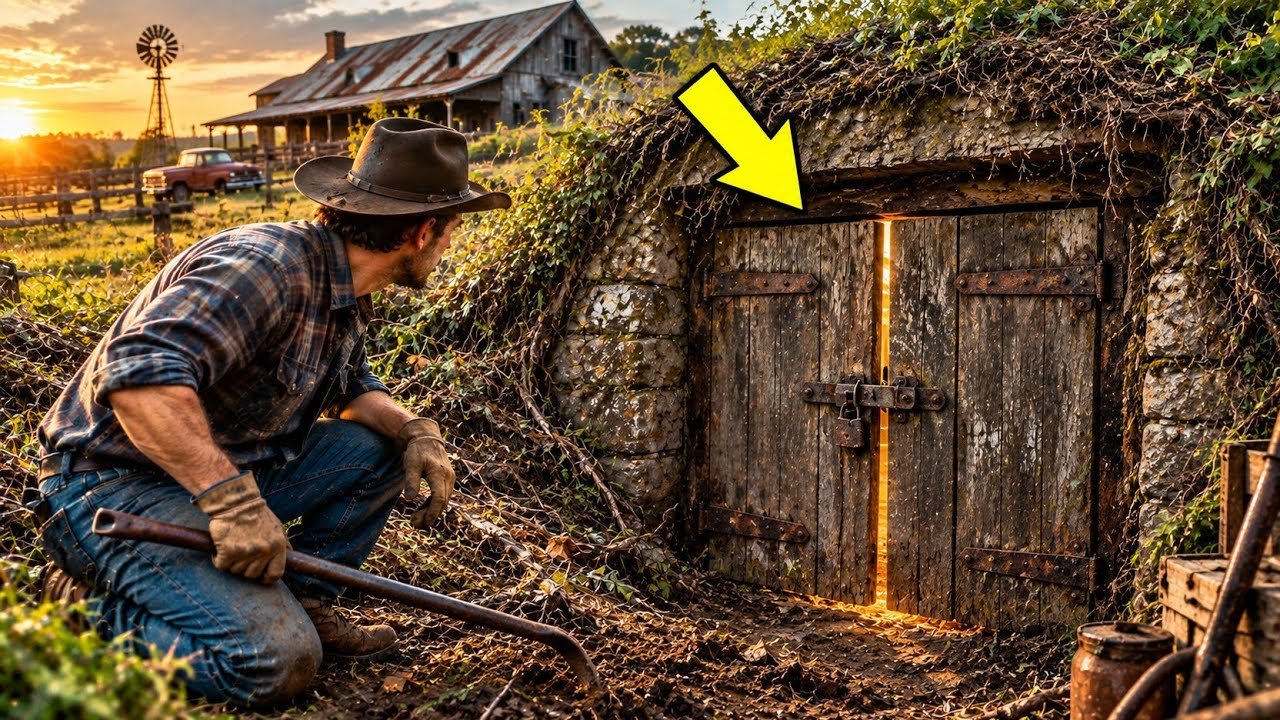
Part 3 🚜
Caleb sat in that cold stone room for a long time.
Pa said to wait for the Vances.
That newer handwriting had to be Howard Miller’s. Eli’s son.
Eli died in 1956.
Howard kept the farm. But he wasn’t a machinist like his father.
He couldn’t run the exchange.
He also couldn’t bear to sell it off to scrap dealers. Or let strangers loot it.
So he greased the hinges. Set the counterweight lock. Sealed the steel doors.
And let the woods grow over the entrance.
He’d been waiting.
For thirty-one years.
For a Vance to come home and settle a debt from 1942.
By the time Howard died in that nursing home, his memory was gone.
His grand-nieces never knew the vault existed.
And somehow, out of every buyer at that auction, the land had ended up with a Vance anyway. 🥹
But Caleb had a problem of his own that fall.
His 1952 International Harvester Super M tractor had snapped its main drive gear two weeks earlier.
The nearest salvage yard in St. Louis wanted $380 for a worn-out used one.
Money he needed for cattle feed.
He ran a work light off his truck generator and searched the shelves on the east wall.
Shelf four. A tag: IH Drive 38.
Wrapped in thick wax paper, coated in clear oil…
A reconditioned drive gear.
And a little handwritten tag in Eli’s neat script.
Super M gear. Cut 1948. Ready for use.
Caleb laughed out loud.
Alone. In a hole in the ground. With his eyes stinging. 😂😭
By Sunday afternoon, the gear was in.
The old Super M fired up on the very first try.
Quiet. Smooth. Pulling a full hay trailer straight up the south slope like it was 1952 again.
Caleb had his hay in before the first freeze.
Thanks to a man who died before he was born.
Then, the second week of October, a truck came flying up his drive.
A young farmer jumped out. Mid-twenties. Grease to his elbows. Panic on his face.
“Mr. Vance? I’m Jimmy Doyle. My place is north of you.”
Doyle. Caleb remembered the brass tag.
“My grandpa’s old combine threw its main sprocket. Half my soybeans are still standing. Rain’s coming Thursday. Dealer says six weeks for a part. We’ll lose the whole crop.”
His voice cracked.
“My dad said old Mr. Miller used to help folks out with parts. Back in the day. I don’t know why I came. I just… didn’t know where else to go.”
Caleb looked at him a long moment.
Then he grabbed his flashlight.
“Come with me.” 🔦
Jimmy Doyle’s jaw hit the floor when the oak door swung open.
Caleb ran his finger down the ledger index.
Doyle. Combine parts. Rack 7.
Rack seven. Second shelf.
A sprocket. Wrapped in wax paper. Tagged in Eli’s handwriting.
For the Doyle combine. Spare. 1951.
Jimmy held it like it was made of gold.
“How much do I owe you?”
Caleb thought about his grandfather’s axle.
No charge. Return scrap iron when able.
“Same terms as always,” Caleb said. He tapped the ledger. “Bring back some scrap iron when you’re able. And help the next fella who needs it.”
Jimmy’s eyes filled.
He beat the rain by eleven hours.
Every last bean came in dry. 🌧️
Word spread through Texas County the way it always does.
At the feed store. After church. Across fence lines.
The old Miller vault is open again.
Over that winter, Caleb had visitors.
Old Walt Mercer came by. Ninety years old, on two canes.
He stood in the vault doorway and cried.
“Eli Miller saved my daddy’s farm in ‘38,” he whispered. “I was just a boy. I carried the scrap iron down here myself.”
He touched the cold stone wall.
“I thought this place died with Howard.”
“It didn’t,” Caleb said. “It was just waiting.” 🥹
Then one cold morning in December, Caleb loaded his truck.
He drove to three different salvage yards.
And came back with a pile of old scrap iron.
He weighed it on the farm scale.
Two hundred pounds. Exactly.
He hauled it down into the vault and stacked it neatly beside the workbench.
Then he opened the ledger to page 114.
Next to his grandfather’s name.
Next to NEVER SETTLED.
Next to Pa said to wait for the Vances.
He picked up a pen. His hand was shaking.
And in careful letters, he wrote:
Settled. December 1987. 200 lbs scrap iron returned. Caleb Vance, grandson of Thomas.
He sat there a long time after that.
Forty-five years.
A promise between two farmers who’d both been gone for decades.
And it was finally kept. 😭
He didn’t empty the vault.
He didn’t call an auction house or antique dealers, even though those old tools would have fetched thousands.
Instead, he spent three days cleaning it.
He swept the floor. Replaced the cracked cork seals in the air vents. Oiled every tool on every shelf.
Then he set a new leather notebook beside Eli’s 1937 ledger.
On the first page, he wrote:
Miller Vault. Built 1937.
Reopened by Caleb Vance, October 1987.
Super M gear recovered and put back to work.
Stock kept for the next neighbor who needs it.
He added his own spare set of wrenches to the bench.
And three spools of copper wire saved from an old barn.
Then he pulled the oak door shut.
The counterweight dropped. Thunk.
He locked the steel doors with two new brass padlocks.
And gently pulled the grapevine back over the stone. 🌿
The next spring, Caleb drove to Springfield.
He found Howard Miller’s grave in a quiet cemetery on a hill.
He set down a small brass tag.
The one stamped Vance. Orchard Ridge.
“You waited a long time,” he said quietly. “Sorry we were late.”
Then he drove home.
Jimmy Doyle’s truck was in his driveway.
With two hundred pounds of scrap iron in the bed.
And a grin from ear to ear.
“Paid in full, Mr. Vance,” he said. “And I put my name in your notebook. For next time somebody needs me.” ❤️
Eli Miller never built that vault to be remembered as a rich man.
He built it because he understood something simple about country life.
Machines break. Money runs dry. Hard times always come back around.
And a community’s real strength is what people quietly set aside to help each other.
When nobody’s watching.
When nobody can pay.
When all you’ve got is a promise.
And someone willing to wait forty-five years to see it kept. 🌄
✨ True wealth isn’t what you keep for yourself. It’s what you quietly save for the neighbor who’ll need it someday. And a promise kept, even 45 years late, is still a promise kept.
💬 Have you ever found something left behind by the people who lived on your land before you? Tell me your story in the comments!