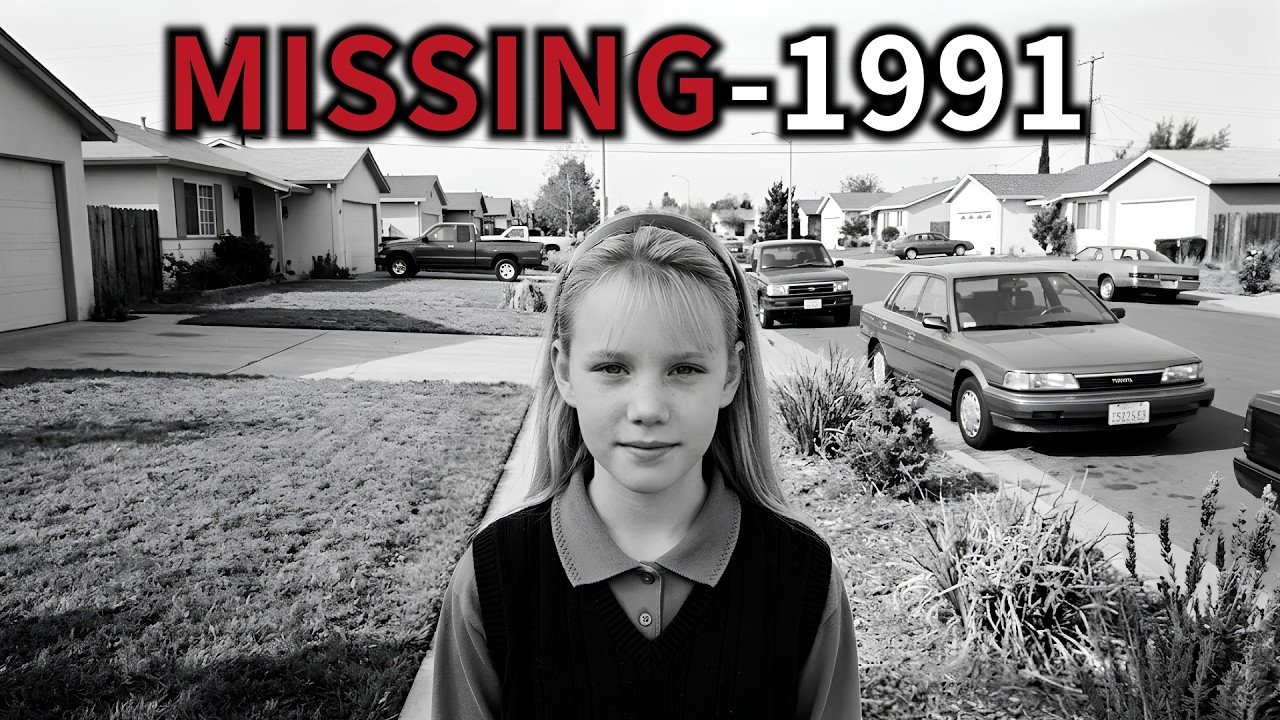
CALIFORNIA 1991 Cold Case Solved — Arrest Shocks Community
...
Jaycee was repeatedly raped by Phillip Garrido beginning from the moment she was kidnapped at age 11.
This continued throughout her many years in captivity while the parole system continued to record him as compliant with his conditions.
In 1994, when Jaycee was 14 years old, she gave birth to her first daughter, Phillip Garrido's child, born inside the backyard compound with no doctor, no hospital, and no medical support for the 14-year-old mother or the newborn.
In 1997, when Jaycee was 17, she gave birth to her second daughter under similar conditions.
The two girls grew up in the backyard compound.
No school, no birth certificates, no legal records confirming their existence in the outside world.
Garrido told anyone who asked that they were his granddaughters.
The birth of her first child completely changed Jaycee's life.
She was no longer just thinking about herself, but about a child who needed her.
It gave her a reason to keep living and also prevented her from taking any desperate actions.
Phillip Garrido did not keep Jaycee through force alone.
He built a complex and thorough system of psychological control over 18 years, combining complete isolation, total economic dependence, and fanatical religion.
Garrido saw himself as a prophet with a special religious mission entrusted by God, creating a closed worldview inside the compound where Jaycee and her two daughters lived as if it were the only reality they knew.
Jaycee later wrote in her memoir, A Stolen Life, about the complex psychological process she went through during those years, about learning how to survive and protect her two daughters in a situation where there were no other choices, and about why escaping was not as simple as outsiders imagined.
While Jaycee and her two daughters lived in the backyard compound at 1554 Walnut Avenue, and Phillip Garrido continued building more tents and sheds to expand the prison area, the federal parole system was following its standard procedures.
In the 10 years from 1999 to 2009, Phillip Garrido's parole officers conducted 60 checks at his Walnut Avenue home.
They came to the house, knocked on the door, talked to Garrido in the front, noted in their files that the parolee was complying with conditions, and left.
60 times in 10 years, and in all 60 of those visits, not a single parole officer went into the backyard to check the compound that Garrido had built and continued expanding over the years right behind the front house, despite a full property check being a basic requirement when supervising a sex offender on parole, despite Garrido having a history of kidnapping and holding victims, and despite his record being more than enough for any parole officer to understand that a superficial check at the front door was not sufficient.
Jaycee and her two daughters lived just a few meters away from those parole officers, separated by only a fence and some coverings, but law enforcement chose not to step into the backyard of the man they were responsible for monitoring to protect the community.
In 2006, when Jaycee had already been held for 15 years and her two daughters were growing up in the compound, a neighbor of Garrido reported to local Antioch police that people were living in tents in Garrido's backyard and that children's voices were coming from the covered area.
This was information from someone living close enough to see and hear it.
The kind of information law enforcement is trained to take seriously.
Antioch police went to 1554 Walnut Avenue.
They talked to Garrido in front of the house.
They still did not go into the backyard, again.
They left and filed a report that there were no issues at the address.
Jaycee, her two daughters, and 15 years of evidence of captivity were right behind the gate that the officers stood in front of before turning around and leaving.
In 2008, the parole agency conducted its own investigation into Garrido after receiving information about his strange behavior.
Investigators went to 1554 Walnut Avenue, questioned him about his activities, and once again, no one checked the backyard.
The compound remained undiscovered.
Jaycee and her two daughters remained unseen.
One year later, two campus officers at UC Berkeley would discover what dozens of parole officers and local police had failed to find in 18 years.
Not with a special warrant, not with advanced technology, but with something none of the previous checks had used, basic human intuition when looking at a situation and realizing something was wrong.
On August 24th, 2009, Phillip Garrido came to the UC Berkeley campus in Berkeley, California along with two teenage girls, his biological daughters with Jaycee Dugard, to request permission to hold a religious event for his group called God's Desire.
Jaycee was not present at UC Berkeley that day.
She was still being held in Antioch.
The first person to receive him was Lisa Campbell, manager of the UCPD events office, who was responsible for issuing permits for events on campus.
Campbell immediately sensed something was wrong.
Garrido's fanatical and strange demeanor, the way he talked about his religious mission like someone unstable, and the two girls with him who appeared sullen and submissive.
Campbell did not ask directly, but scheduled a follow-up meeting for the next afternoon, and immediately reported to Officer Ally Jacobs of the UC Berkeley Police Department.
Jacobs ran a background check on Garrido through dispatch, and discovered he was a registered sex offender on federal parole for kidnapping and rape since 1976.
Red flags went up immediately.
A registered sex offender appearing on a university campus with two girls he claimed were his daughters, while his parole officer had no record showing he had children.
On August 25, Jacobs and Campbell met Garrido for a second time in Campbell's office, keeping things normal and not letting him know they were investigating, with the goal of preventing him from fleeing before parole could act.
He opened his bag and pulled out a self-published book about schizophrenia.
After that meeting, Jacobs contacted parole officer Edward Santos Jr.
directly, informing him about the existence of the two girls, Garrido's unusual behavior, and everything the two had observed over the two days.
Santos recognized this as serious new information not in Garrido's file, and immediately summoned him to the parole office in Concord, requiring him to bring everyone with him.
On August 26, 2009, Garrido arrived at at Concord parole office with Nancy Garrido, the two teenage girls, and a young woman he introduced as Alyssa, telling investigators she was his niece.
Investigators separated each person for questioning.
During the interrogation, Garrido eventually confessed that he had kidnapped and raped Jaycee Dugard in 1991.
The young woman sitting in the interrogation room, who had lived for 18 years under the name Alyssa in the tent compound behind Garrido's house in Antioch, confirmed her real identity.
The 11-year-old girl who had stood waiting for the school bus in Meyers, California on the morning of June 10th, 1991, the one whose stepfather Carl Probyn had jumped on his bike to chase the kidnapper's car, but couldn't catch it, was now a 29-year-old woman sitting in the Concord Parole Office after 18 years in captivity, speaking her real name for the first time to authorities.
On the night of August 26, 2009, Jaycee Dugard and her two daughters were taken by authorities to a safe location, far from the house in Antioch, far from the tent compound that had been their entire world for 18 years.
The FBI arranged a phone call between Jaycee and her mother, Terry Probyn, who was in Southern California at the time, the first time the two had heard each other's voices in 18 years, 2 months, and 16 days.
On the morning of August 27th, Terry flew to Northern California and reunited in person with her daughter and the two granddaughters she had never known existed.
Aunt Tina Dugard, who was present at the reunion, described it to the press.
"The smile on my sister's face was as wide as the ocean.
Her oldest daughter was finally home".
We laughed, we cried, we enjoyed each other's presence.
Jaycee remembered all of us, and the painful detail the whole family only learned after the reunion.
Throughout those 18 years, Jaycee had been held in Antioch, California, just under 200 miles from her home in South Lake Tahoe.
While Terry Probyn searched for her daughter across California and Nevada and prayed that Jaycee was alive somewhere, Jaycee had been living less than a 2-hour drive away the entire time.
Phillip and Nancy Garrido were arrested on August 26th, 2009 at the Concord parole office after Phillip confessed to his parole officer.
The initial list of charges was long: kidnapping, false imprisonment, multiple counts of rape including rape in concert with kidnapping, lewd acts with a minor under 14, and many other charges related to the 18-year crime spree.
Both initially pleaded not guilty.
The legal proceedings dragged on for nearly 2 years with multiple hearings, delays, and increasing pressure from the El Dorado County District Attorney's Office to resolve the case without putting Jaycee and her two daughters on the witness stand in court.
In April 2011, nearly 2 years after their arrest, Phillip Garrido pleaded guilty to one count of kidnapping and 13 counts of sexual assault including six counts of rape and seven counts of lewd acts.
Nancy Garrido pleaded guilty to one count of kidnapping and one count of forcible rape along with California's one strike law for rape.
This agreement was reached after prosecutors agreed to drop some charges against Nancy Garrido if Phillip pleaded guilty to nearly the entire indictment.
Both waived their right to appeal as part of the deal.
The plea deal was designed in part to spare Jaycee and her daughters from having to testify in court.
Jaycee released a statement immediately after both pleaded guilty.
"I am relieved that Phillip and Nancy Garrido have finally admitted their guilt and confessed to the crimes they committed against me and my family".
On June 6, 2011, the sentencing hearing took place at El Dorado County Superior Court in Placerville, California.
Jaycee was not present in the courtroom.
She wrote in her statement, "I choose not to be here today because I refuse to waste one more second of my life in your presence.
Everything you did to me was wrong, and I hope one day you realize that".
"I hated every single second of every single day for 18 years.
You stole my life and the life of my family".
She also wrote about Nancy Garrido, "There is no god in this universe who accepts what you did.
I hope both of you have as many sleepless nights as I have had".
Jaycee's statement was read aloud in the courtroom by her mother, Terry Probyn, the woman who had lost her daughter 18 years earlier and now stood in court reading the words her daughter had written.
Judge Douglas C.
Kimister called Phillip Garrido the poster child for a sex offender and sentenced Phillip Garrido to 431 years to life in prison and Nancy Garrido to 36 years to life.
Nancy Garrido received the maximum sentence possible under the criminal laws in effect in 1991 when the crimes were committed.
Phillip Garrido, 60 years old at the time of sentencing, would not be eligible for parole for many decades.
The 431 year sentence ensured he would die in a California prison.
After the sentences were handed down, the remaining question was not about the two Garridos, but about the system that had allowed it to happen.
Phillip Garrido was a registered sex offender on federal parole for kidnapping and rape since 1976 when he kidnapped Jaycee in 1991, meaning the parole system knew exactly who he was and what he was capable of and still failed to stop him.
In the following 18 years, dozens of investigators came to his house to check parole conditions, and none of them entered the hidden compound behind the house where Jaycee was being held with her two daughters.
A neighbor reported suspicious activity at the Garrido house to police in 2006 with no meaningful action taken.
investigators came to the house in 2008, still no check of the compound.
Jaycee sued the state of California over those systemic failures, and California settled the lawsuit for $20 million, the largest settlement in the state's history for parole system failures, and an acknowledgement that what happened to Jaycee Dugard over those 18 years was not only the crime of Phillip and Nancy Garrido, but also a systemic failure by those tasked with preventing exactly that.
In the years after her rescue, she not only survived, but recovered in a way her former therapist described to the press as living remarkably well.
Someone proud of what she has accomplished in the years since leaving the backyard compound in Antioch.
In 2011, Jaycee published A Stolen Life, a memoir recounting her 18 years in captivity.
The book became a best seller and was widely regarded as one of the most honest and courageous survivor memoirs ever written.
Not because it dwelled on horrific details, but because it told the truth about the psychology of someone living in unimaginable circumstances, a truth that only someone who lived through it could tell accurately.
Jaycee founded the JAYC Foundation, an organization supporting families and victims of abduction, with a special focus on helping families reintegrate and recover from traumas that ordinary medical and legal systems are not designed to fully handle.
Jaycee turned the 18 years that were taken from her into something that could help others, a choice no one had the right to demand of her, and no one could make for her, but one she chose to make.
The Jaycee Dugard case leaves three lessons that anyone concerned with child safety and the integrity of the justice system needs to know.
The first lesson is about the decision to release Garrido after 11 years and not listening to the victim's warning.
Phillip Garrido was sentenced to 50 years in federal prison in 1976 for kidnapping and raping Katherine Hall, released after 11 years.
And when victim Hall warned his parole agent that Garrido was continuing dangerous behavior, the agent noted in the file that electronic monitoring would be too complicated based on the victim's hysteria.
Three years later, Garrido kidnapped Jaycee.
The parole system and courts need to take the risk of reoffending by sex offenders far more seriously before release, and must listen to victims instead of dismissing their warnings as hysteria.
The second lesson is about the 60 parole checks where no one went into the backyard.
This was not the failure of any single individual, but a systemic flaw.
Parole check procedures for sex offenders with a history of kidnapping and holding victims must require a full property inspection, not just a conversation at the front door.
The $20 million California paid Jaycee is an acknowledgement that this was a systemic error, not money that can compensate for 18 years, but a legal admission that the system failed in a way that could have been prevented.
The third lesson is about officers Ally Jacobs and Lisa Campbell, the two UC Berkeley campus officers who had no special warrant, no DNA, and no forensic technology.
They only had the intuition that something was wrong when they looked at Garrido and the two young girls with him, and they acted on that intuition instead of letting the man walk away like dozens of parole officers and police had done in the previous 18 years.
If you see something wrong, a child who looks afraid, an adult exerting excessive control over those around them, a situation where your intuition says something is not normal, report it.
You don't need to be 100% sure, just report it and let the authorities check.
If you've watched this far, leave a comment and let us know where you're watching from, and hit subscribe so you don't miss the next videos.